
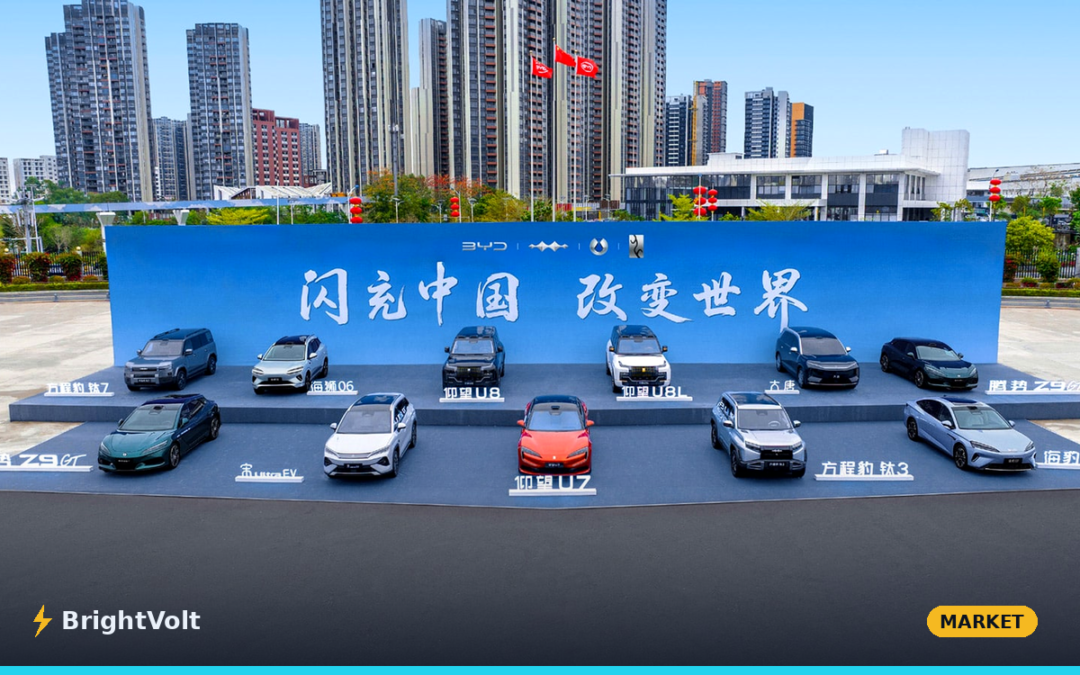
BYD is handing a competitor its best battery. On 20 August, FAW’s Hongqi became the first outside brand confirmed to get BYD’s second-generation Blade battery and its Flash Charging system — the two technologies BYD had, until now, kept for its own cars. It comes as BYD’s global battery share is sliding: 14.4% for January–May 2026, down from 16.7% a year earlier, while CATL pulls away to 40.2%. That combination is the story. A company losing share is opening its crown-jewel product to a rival.
What Hongqi is getting, and what “first” means
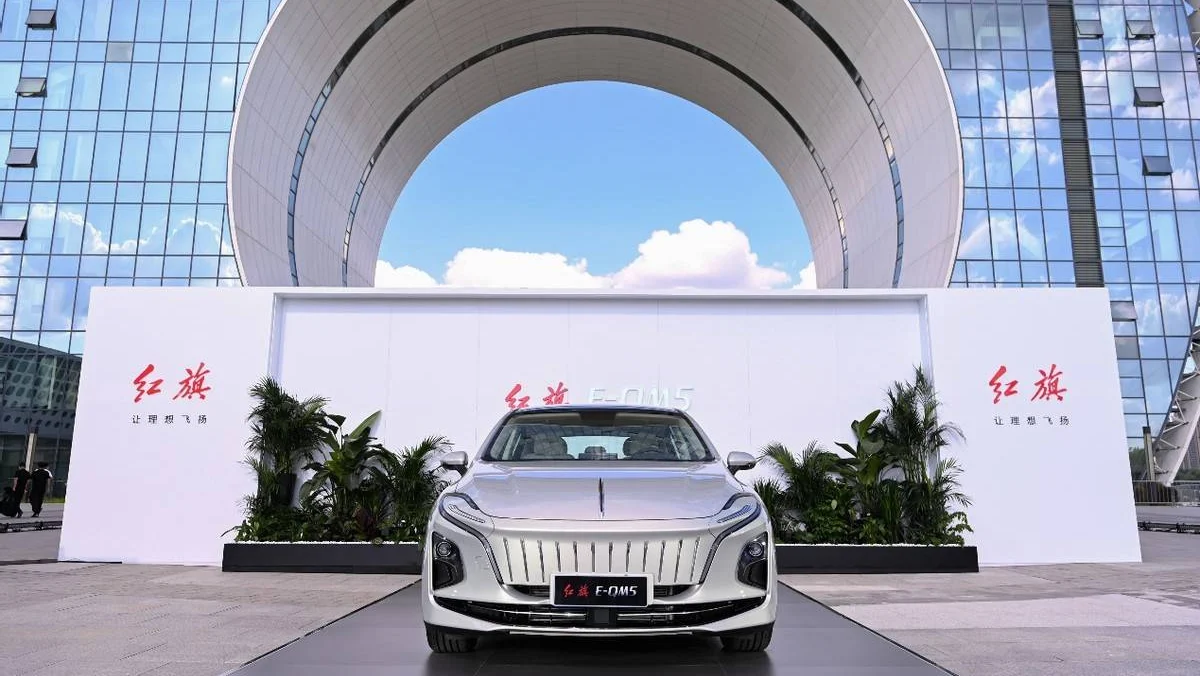
The vehicle is the Hongqi E-QM5, with a coming pure-electric platform to follow. The cells come from FAW-FinDreams, the battery joint venture between BYD’s cell arm FinDreams and the state-owned First Automobile Works. It is a ¥180 billion (about $26.5 billion) project for 45 GWh of annual capacity across three 15 GWh phases; the first phase broke ground in February 2024 and reached what the partners call stable mass production on 15 August. At full build it can supply batteries for roughly 600,000 vehicles a year.
“First” needs a careful reading, because BYD has sold Blade cells to outsiders before. FinDreams agreed in 2024 to supply first-generation Blade cells to the American supplier BorgWarner, and BYD’s LFP packs already sit under the Toyota bZ3 and, by several accounts, some European Model Y. What is new is the second-generation Blade and Flash Charging — BYD’s newest and best — going to a domestic rival, and a state-owned one at that. This is not offloading last year’s chemistry. It is sharing the current flagship.
The cell itself is worth understanding
BYD launched the second-generation Blade in March, and it is really two cells wearing one name. Both move from plain lithium iron phosphate to LMFP — the same iron-phosphate backbone with manganese added to lift voltage and energy — but they are tuned in opposite directions.
The Short Blade is built for speed: 160 Wh/kg, a peak charge rate of 8C and a discharge rate of 16C, enough to take a pack from 10% to 70% in five minutes. The Long Blade is built for range: 190–210 Wh/kg at the system level, a gentler 3C charge, and enough energy to carry a 120 kWh Denza Z9GT to 1,036 km on China’s CLTC cycle. The headline charging figures — 10% to 97% in nine minutes, or twelve minutes at −30°C — belong to the fast variant, and they only appear on BYD’s own 1,500 kW Flash Charging hardware, an 8C rate that most public chargers cannot deliver.
| Short Blade 2.0 | Long Blade 2.0 | |
|---|---|---|
| Chemistry | LMFP (high power) | LMFP (high energy) |
| Energy density | 160 Wh/kg | 190–210 Wh/kg (system) |
| Peak charge rate | 8C | 3C |
| Peak discharge rate | 16C | 8C |
| 10–70% charge | ~5 minutes | slower |
| Built for | performance, PHEV | maximum range |
Handing Hongqi both variants means handing it the whole toolkit — the fast cell for a performance platform and the dense one for a long-range one.
The share numbers behind the decision
Look at the market and the deal stops looking like generosity. Global EV-battery use in the first five months of 2026 was 469.2 GWh, up 16.3% on the year, according to SNE Research. CATL took 40.2% of it, up 2.2 points. BYD took 14.4%, down from 16.7% — its installed volume grew just 0.4% while the market around it grew sixteen times faster.
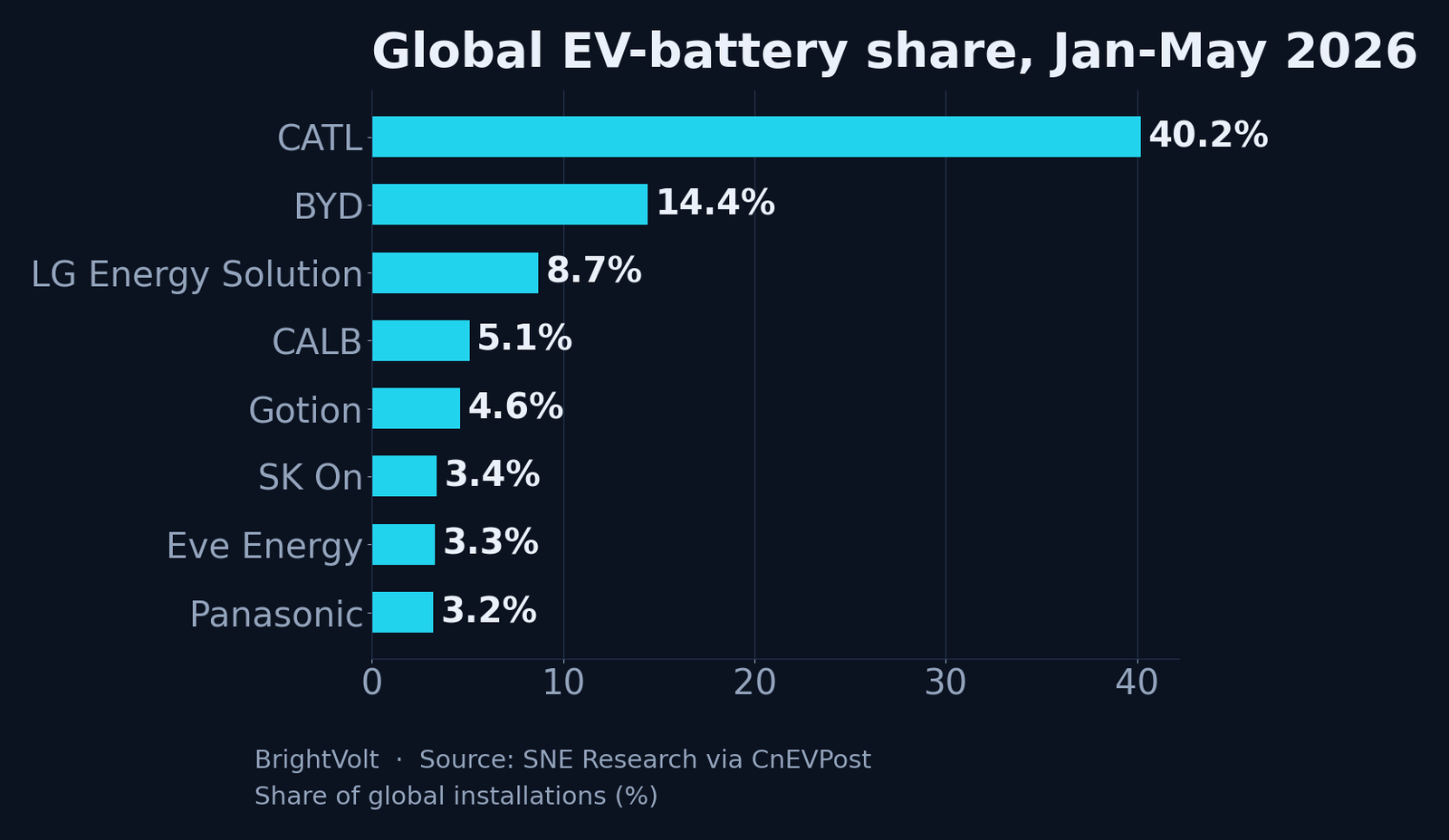
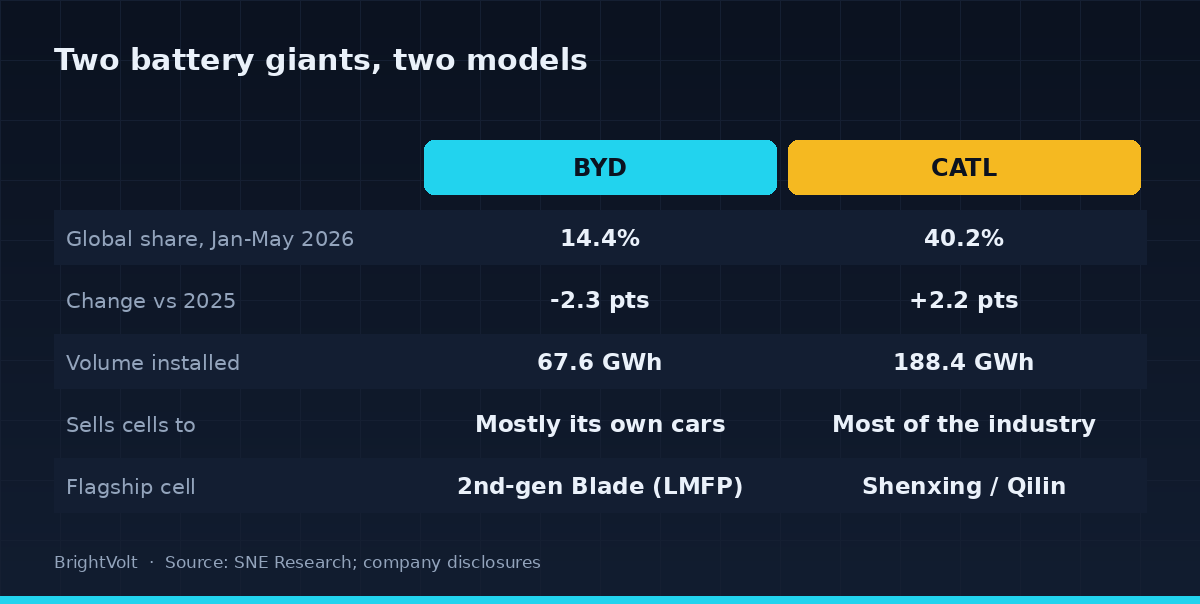
The reason is structural, and it is the whole point. BYD’s battery share is mostly a reflection of its own car sales, because almost every cell FinDreams makes goes into a BYD. When BYD’s vehicle growth cools — and in 2026 it has — the battery number cools with it, mechanically. CATL has no such ceiling. It sells to Tesla, Ford, BMW, Volkswagen, NIO and most of the rest, so its battery share rides the entire industry’s growth rather than one carmaker’s. Two firms, two business models, and the gap between them is now widening every month.
From captive supplier to merchant
The Hongqi deal is BYD deciding it no longer wants FinDreams tied to BYD’s own showroom. A battery arm that only feeds the parent is capped at the parent’s success; a battery arm that sells to everyone grows on the whole market’s back. CATL proved that model works. BYD is now, cautiously, copying it — and doing so with its best product rather than its cast-offs, because a merchant supplier that offers rivals only its old chemistry does not win the contracts.
The obvious objection is that this arms a competitor. Give Hongqi the second-generation Blade and Flash Charging and you have helped a state-owned brand build a faster-charging, longer-range car to sell against you. That is true, and BYD has evidently decided the trade is worth it. Hongqi is a premium and government-fleet marque that barely overlaps with BYD’s mass-market Ocean and Dynasty lines, so the cars it builds with these cells will not sit next to a BYD on the same shortlist. And FinDreams needs the volume: a 45 GWh plant running half-empty because BYD’s sales plateaued is a far bigger problem than a rival with a good battery. Better to fill the lines and bank the supply margin.
What to watch
Whether Hongqi stays the exception or becomes the template. If other FAW brands — or automakers outside the FAW group — start fitting the second-generation Blade over the next year, BYD has turned FinDreams into a merchant supplier and its battery share should stop tracking its car sales so tightly. If Hongqi remains a one-off, tied up in the specifics of a state-backed joint venture, then this is a bespoke arrangement rather than a strategy, and the captive-supplier reading was right. The tell will be in the reporting: watch for BYD beginning to break out external battery volume as a line worth boasting about. Companies disclose what they have decided to grow.
Image: BYD · Image: FAW