
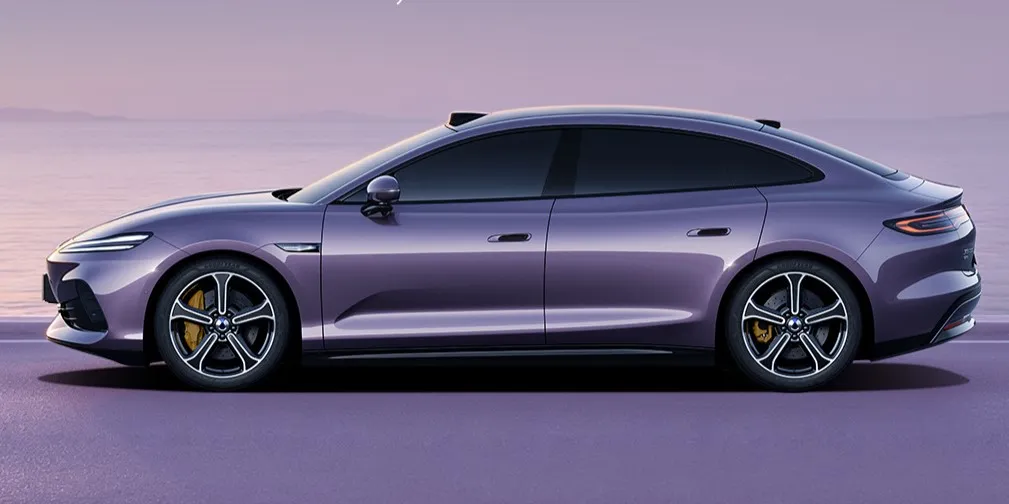
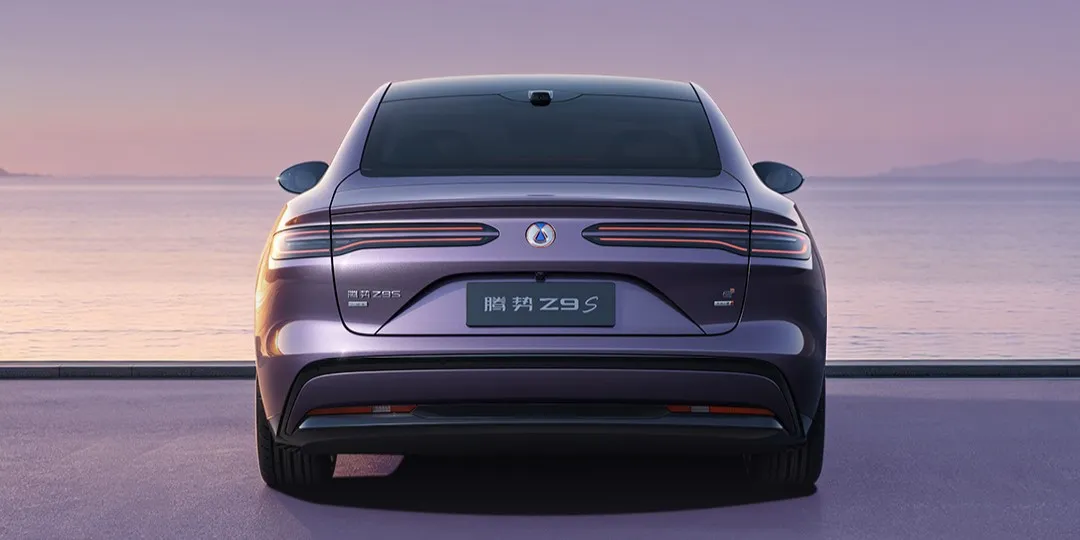
Denza, BYD’s premium marque, launched the Z9S on 23 September 2026 with a record bolted to the press release: at 1,100 km on China’s CLTC cycle, it is the longest-range mass-produced electric car on sale. The figure is genuine. It is also the least revealing number on the car, because the record was bought with a bigger battery rather than a more efficient vehicle.
That distinction is the whole story of a range claim, and it is the one part manufacturers never put on the slide.
What the 1,100 km figure actually measures
CLTC is China’s domestic test cycle, and it is the most generous of the three standards a buyer is likely to meet. It runs at lower average speeds than Europe’s WLTP or America’s EPA, with gentler acceleration and no sustained motorway leg, so it flatters range in exactly the conditions — high speed, cold, hills — where an EV loses it. BrightVolt has a full explainer on how the three cycles diverge; the short version is that a CLTC number is not wrong, it just answers a question most drivers are not asking.
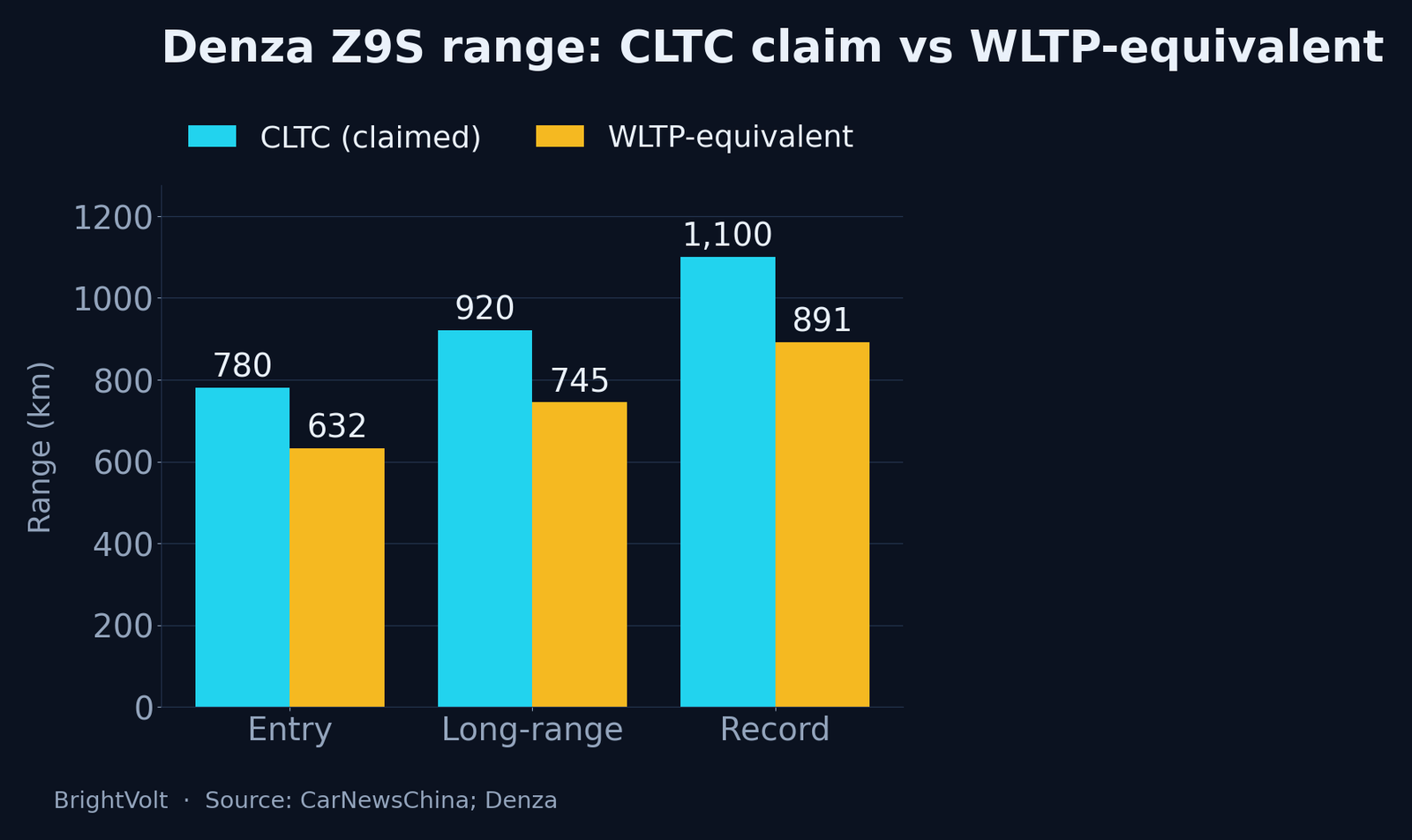
Denza knows this, which is why the launch materials also quote a WLTP figure: 891 km for the 1,100 km variant, 745 km for the 920 km version, 632 km for the 780 km one, as reported by CarNewsChina from the specification sheet. Line the pairs up and something falls out. Every WLTP figure is exactly 81% of its CLTC twin — 632/780, 745/920, 891/1,100 all return 0.810. That is not what an independent homologation looks like. A car tested on two cycles produces two results that drift apart unpredictably; a single conversion factor applied across a range produces a clean constant. The Z9S is not sold in Europe and carries no EU type approval, so the “WLTP” number is a house estimate, not a certified one. It is the more honest of the two figures, and it is still a calculation, not a measurement.
Where the extra range comes from
Here is the part that decides everything. When Denza opened pre-orders in August, every source — CnEVPost and Electrek among them — listed all three variants on the same 102.3 kWh Blade Battery 2.0 pack. On that pack, 1,100 km CLTC would mean 10.7 km per kilowatt-hour, a number no five-metre SUV has ever come close to. By launch the top variant had quietly grown a 122.5 kWh battery, 20% larger, which is what CarNewsChina’s specification sheet now shows.
Run the arithmetic on the launch figures and the record dissolves.
| Variant | CLTC range | WLTP-equivalent | Battery | Implied use (WLTP) | Price |
|---|---|---|---|---|---|
| Entry | 780 km | 632 km | 102.3 kWh | 162 Wh/km | ¥319,800 (~$45,700) |
| Long-range | 920 km | 745 km | 102.3 kWh | 137 Wh/km | ¥349,800 (~$49,200) |
| Record | 1,100 km | 891 km | 122.5 kWh | 138 Wh/km | ¥389,800 (~$55,700) |
The 920 km car and the 1,100 km car use energy at the same rate — about 137 Wh/km on Denza’s own converted figures. The record variant is not more efficient than the one below it. It simply carries a fifth more battery to go a fifth further, which is not an engineering breakthrough so much as a bigger fuel tank. The interesting car is the 920 km version: same pack as the entry model, 45% more range, because it is the efficient single-motor tune rather than the heavier one.
The efficiency the numbers imply, and why it cannot be real
A figure of 137 Wh/km is where the claim stops being optimistic and starts being physically hard to credit. The Z9S is 5,090 mm long and 1,980 mm wide, a full-size luxury SUV with up to three motors. On Denza’s own WLTP conversion it would use less energy than a Tesla Model 3 — a car two sizes smaller, far lower, and roughly a tonne lighter — and about a third less than any comparable large EV actually homologated in Europe.
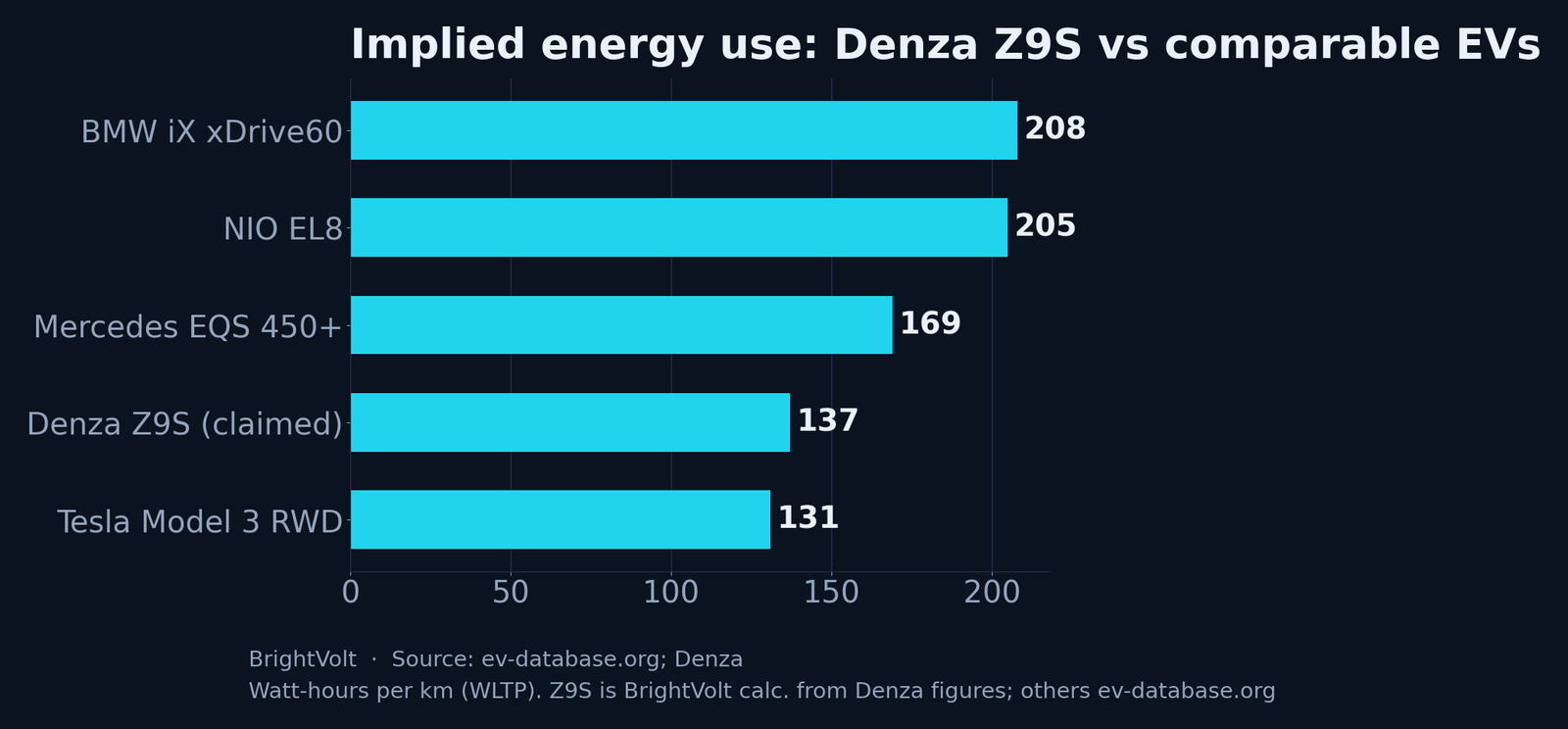
The comparison set is not flattering. A Mercedes EQS 450+, the most aerodynamic large saloon on sale, is homologated at 169 Wh/km; a BMW iX xDrive60 at 208; NIO’s own EL8, a large electric SUV built in the same market, at 205, according to ev-database.org. For a two-tonne-plus SUV with the frontal area of a wardrobe to undercut all of them by 30% and match a compact saloon would require an aerodynamic and drivetrain result nobody else has managed. The likelier explanation is the one the cycle already told us: CLTC is generous, and an 81% haircut is not enough to make it stop being generous.
The parts of the car that are not in dispute
Strip out the range headline and the Z9S is still a serious piece of engineering, and this is where the numbers hold up. The tri-motor version makes 890 kW — 1,193 hp — and reaches 100 km/h in 2.68 seconds, figures a physics-defying range claim tends to overshadow. It rides on BYD’s 1,000-volt flash-charging architecture, which the company rates at 10 to 70% in five minutes; that is the genuinely grid-relevant number, and one BrightVolt has looked at as a buffering technology in its own right. Rear-wheel steering trims the turning circle of a five-metre car to 4.75 m. At ¥319,800 to ¥389,800, roughly $45,700 to $55,700, it undercuts every European rival it will never be sold alongside.
None of that needed a range record. The Blade 2.0 pack, the charging speed and the price are the story a buyer can actually use, and they are all verifiable. The 1,100 km is the part that will not survive contact with a motorway.
What would change the read
The test is simple and it is coming. If the Z9S reaches a market with independent homologation — a European launch, a Green NCAP measurement, a magazine’s 120 km/h range run — and the certified figure lands anywhere near 891 km, this analysis is wrong and BYD has built the most efficient large SUV on the planet. If it lands where the physics points, somewhere in the 650 to 750 km bracket in real use, then 1,100 km was a test-cycle artifact quoted as a product feature. The number to watch is not the one on the poster. It is the first one measured by someone who does not sell the car.
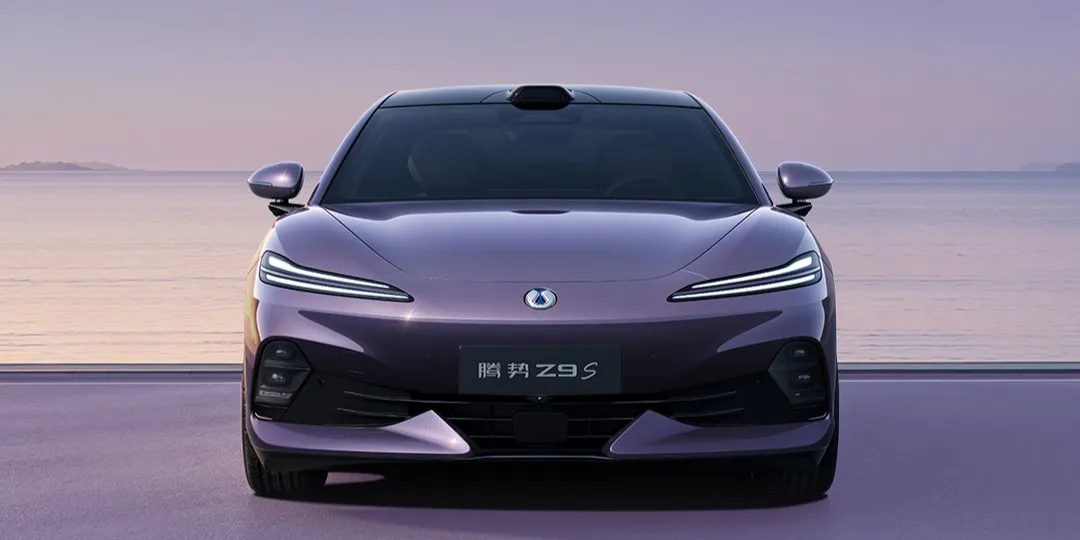
Image: BYD