
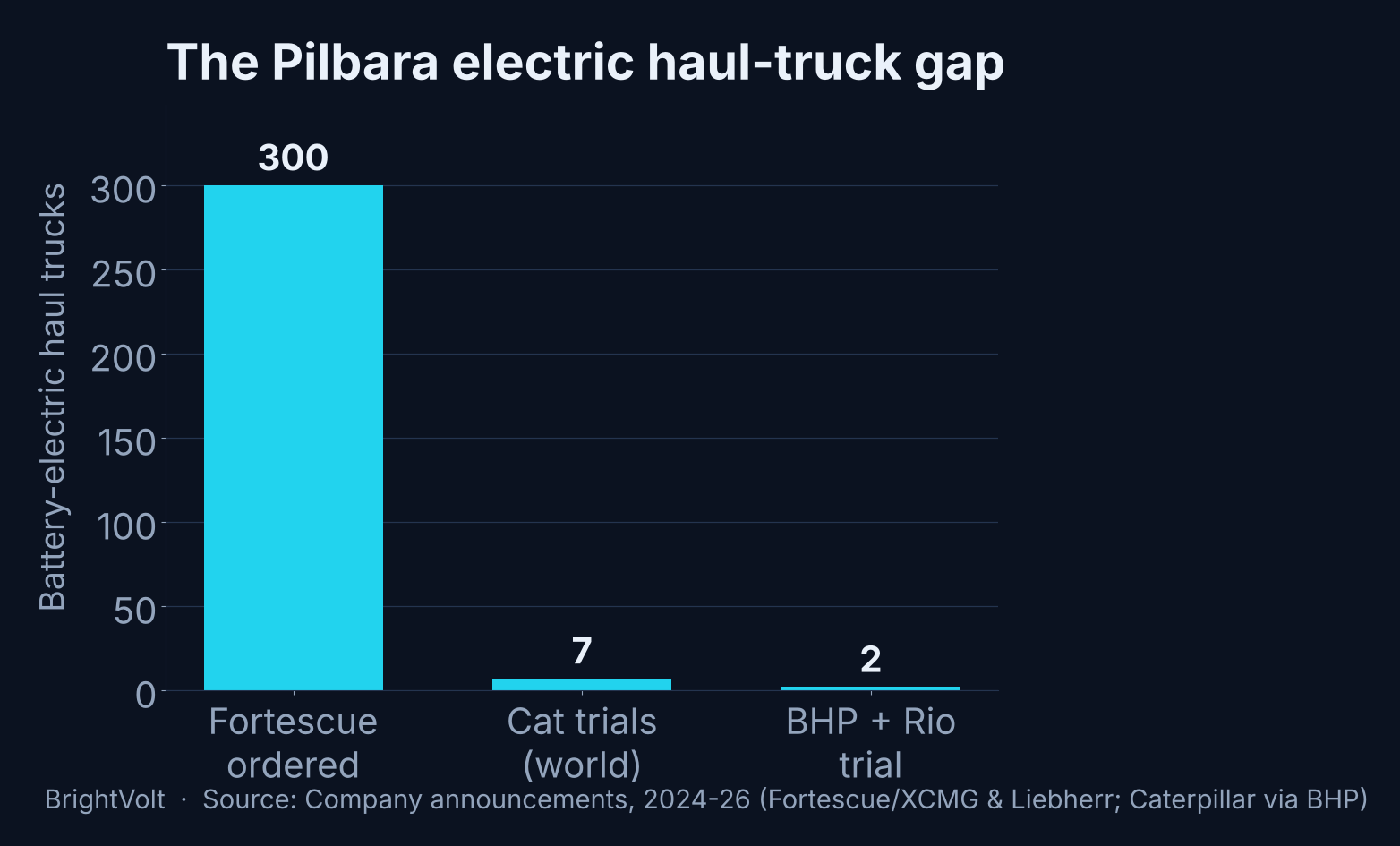
The hardest vehicles in the world to electrify are already going electric — and a growing share of them are being built in China. This week Fortescue shipped its first battery-electric loaders, dozers, graders and water trucks into Western Australia’s Pilbara, machines ordered from the Chinese heavy-equipment giant XCMG. The same company has committed to more than 300 electric haul trucks. BHP and Rio Tinto, the two largest iron-ore miners on earth, are between them trialling two.
That gap is the story. And it is not a story about batteries.
The two-truck trial and the three-hundred-truck order
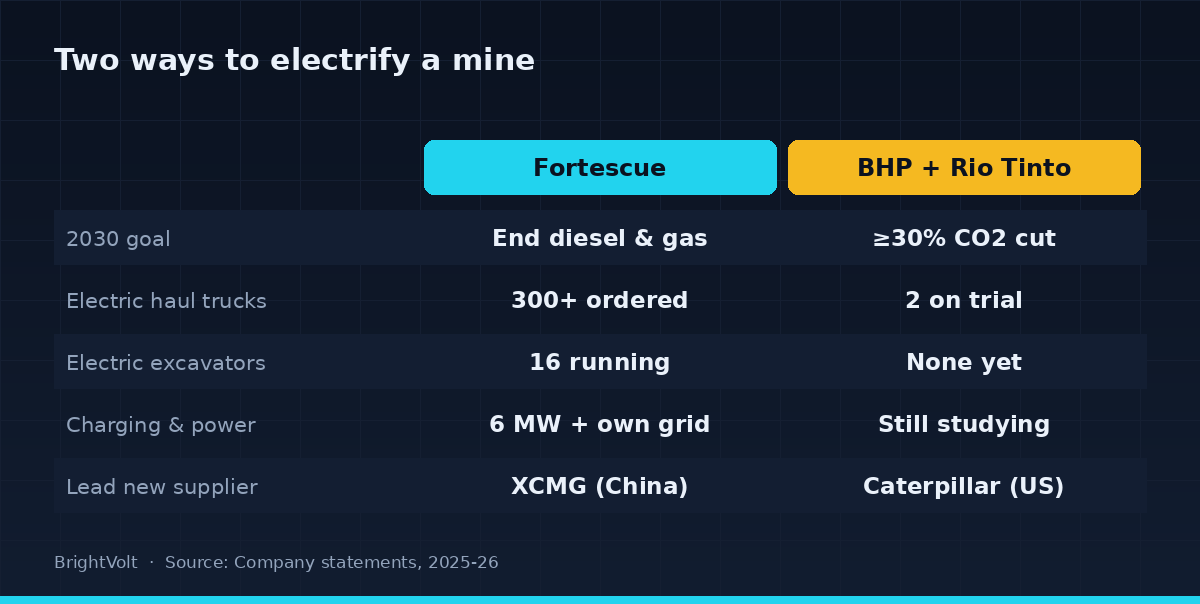
In June, BHP, Rio Tinto and Caterpillar launched a trial of two Cat 793 XE “Early Learner” battery-electric haul trucks at BHP’s Jimblebar iron-ore mine — two of just seven such trucks Caterpillar has running anywhere in the world. The language around it was all caution. The trial would “assess technical readiness, infrastructure requirements and commercial feasibility.” A hundred hours of operation, two hundred test laps, data gathered in “some of the most demanding operating conditions on earth.” BHP’s headline climate goal is a cut of at least 30% in operational emissions by its 2030 financial year. A reduction, carefully hedged.
Fortescue is not hedging. It has told the market it will eliminate fossil fuels from its Pilbara iron-ore operations by 2030 — what the company calls “Real Zero,” meaning the diesel and gas gone rather than offset — and it is buying the machines to do it now. Sixteen battery excavators are already digging, each displacing roughly a million litres of diesel a year, with about half of a seventy-strong excavator fleet due to be electric by the end of this year. It is building its own six-megawatt fast chargers that refill a haul truck in about half an hour, and a $6-billion private grid of solar and storage to feed them.
One miner has decided; the others are still running the experiment. There is a clear reason the heaviest machines electrify first — fixed routes, a depot to return to, and a fuel bill that dwarfs a car’s — and Fortescue has acted on it ahead of everyone else. The interesting question is no longer whether a battery can do the job. It is who gets to build the thing that does.
The machines are increasingly Chinese
This is the part that should trouble Western industry. When Fortescue went looking for the largest fleet of zero-emission mining equipment ever assembled, it did not buy it all from Caterpillar, Komatsu or Liebherr. In September 2025 it placed what XCMG called the largest green-mining export order in China’s history: up to 400 of its 240-tonne electric haul trucks, for delivery between 2028 and 2030. XCMG had already unveiled the world’s largest all-electric wheel loader, built for Fortescue. The dozers, graders and water trucks that sailed this week are the first physical instalment of a $400-million order signed back in 2024.
To be fair about it, this is not a clean sweep. Fortescue has been explicit that at least half of its future haul-truck fleet will stay with Germany’s Liebherr, whose T 264 battery truck carries a pack of around 2.6 MWh. XCMG takes “up to half.” But a year ago the Chinese share of the biggest decarbonisation order in mining was zero, and the trajectory since has pointed one way.
| Date | What Fortescue ordered from XCMG | Status |
|---|---|---|
| Nov 2024 | ~US$400m: 100+ battery loaders, dozers, graders, water carts | Shipping now |
| Sep 2025 | Up to 400 × 240-tonne electric haul trucks | Due 2028–30 |
| Feb 2026 | The world’s largest all-electric wheel loader | Unveiled |
| Oct 2026 | First loaders, dozers, graders and water trucks sail for the Pilbara | In transit |
The pattern will be familiar to anyone who has watched the battery business. China already builds most of the world’s cells and most of its electric heavy trucks. The mine machine is simply the next rung, and the same industrial logic that won China the others — enormous scale, a deep supplier base, and the willingness to ship a product while a rival is still certifying one — is carrying it up.
The incumbents have reasons, and that is the problem
It would be lazy to call BHP and Rio timid, so take the strongest version of their case. Battery haulage genuinely is immature. A 240-tonne truck that runs around the clock in forty-degree heat, hundreds of kilometres from the nearest substation, is a brutal duty cycle, and Caterpillar’s “Early Learner” badge is honest about where the technology sits. Dynamic charging — powering the truck while it drives — is still being trialled, not sold. And a mine fleet is tiny in unit terms: a few hundred trucks against the seventeen-odd million cars Europe buys in a year. Lose it, the argument goes, and barely a line moves.
There is also a subsidy sitting squarely in the way. In Australia, the diesel fuel tax rebate hands mining around A$5 billion a year, and at 52.6 cents a litre it effectively refunds the fuel that a diesel machine burns across its working life. When the state quietly pays your diesel bill, the electric alternative is not competing against diesel; it is competing against free diesel. Fortescue, which wants that rebate capped, is the one miner acting as though the subsidy will not last.
But “the product is immature” is precisely how an incumbent talks itself out of a market while a faster rival builds it. Every word of the majors’ caution is defensible on its own, and the sum of it is a slow-motion surrender. The two-truck trial is prudent risk management and a decision to arrive late, at the same time.
What is actually at stake
Not units. The prize in heavy equipment was never the sticker price of the truck; it is the franchise that follows it — decades of spare parts, servicing, software, autonomy, and the charging standards that the first fleets at scale get to define. Whoever electrifies the Pilbara first writes the rulebook the rest of the industry copies, the way the first mover always has in machines that cost ten million dollars each and run for forty years.
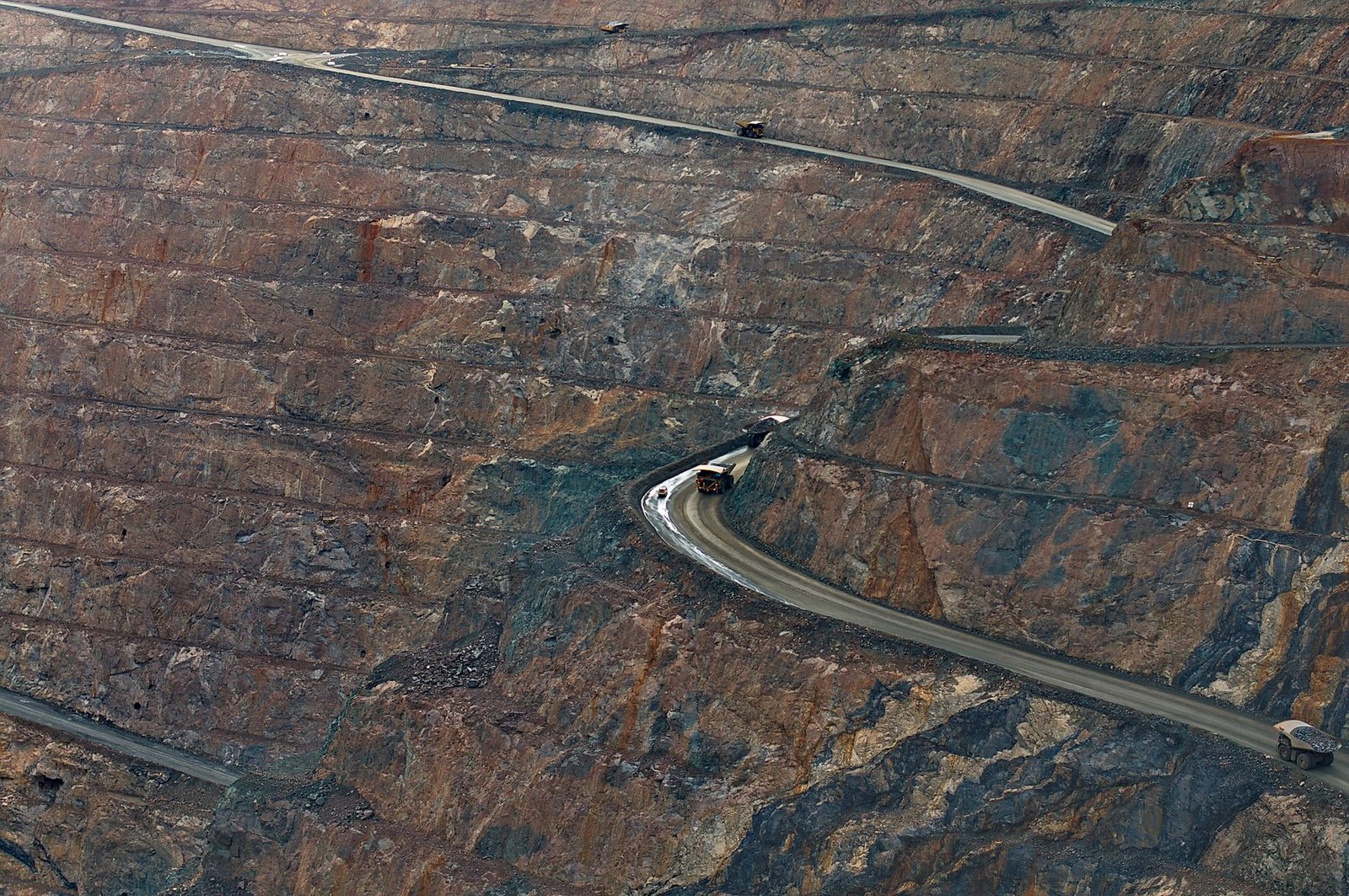
And the diesel underneath it is no rounding error. Australian mining alone burns 9.6 billion litres of it a year. That is the pool an electric fleet drains, and the reason the honest signal of where oil demand finally turns is not the car showroom but the pit, the port and the quarry. China worked this out some time ago. It makes the cell, it makes the truck, and it is now loading both onto ships bound for its customers’ mines.
What would change this read
If Liebherr and Caterpillar convert their incumbency into the majority of the next wave of real orders — orders, not trials — by 2028, then XCMG is a second source and a bargaining chip, not a franchise owner, and this piece is wrong. The thing to watch is the moment BHP or Rio moves from “evaluating” to a fleet purchase, and whose badge is on the trucks when it does. The battery question is settled. The only one left is who gets paid to answer it.
Photo by Mark Thomas on Pexels · Photo by Toygar Par on Pexels · Photo by Mark Thomas on Pexels