
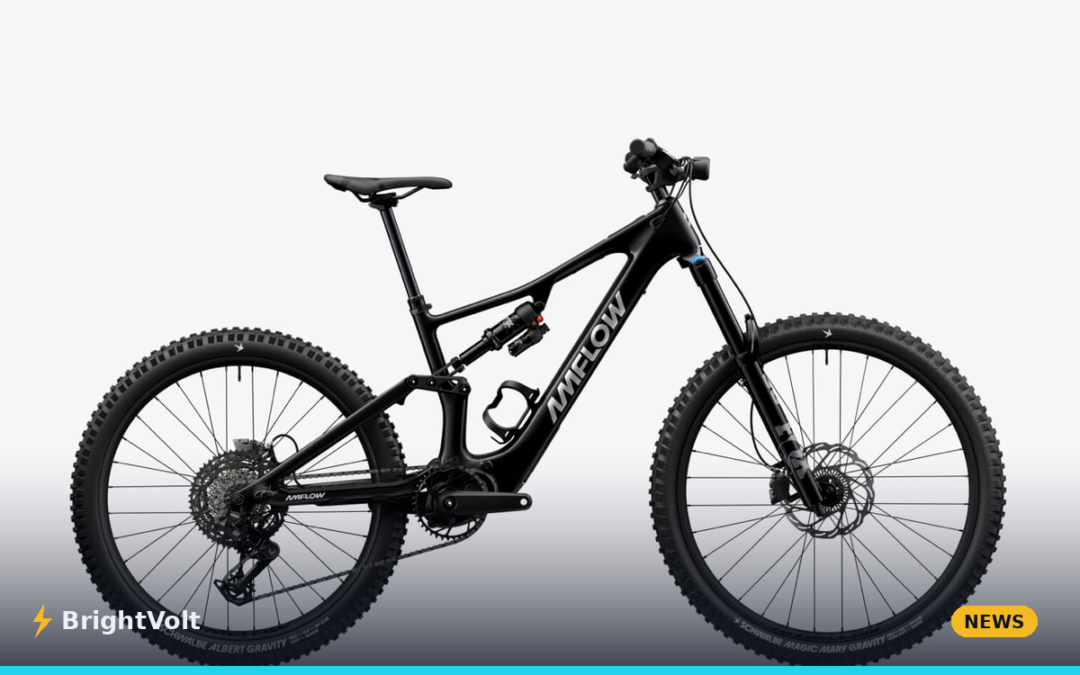
DJI spent twenty years making the numbers on a drone box mean something, and then went into bicycles. Amflow’s 2026 range is three models deep now — the original PL, and the PX and PR launched in April — and the numbers on the box are extraordinary: 150 Nm of torque, 1,500 watts, 144 km of range, a complete bike in the 20 kg class, and a carbon enduro bike starting at £3,999.
Every one of those figures is real. Each of them also means something narrower than it sounds. This is not a ride review — plenty of outlets have ridden these bikes and we have not — but the specification sheet is a document worth reading properly, and DJI has published enough of it to check.
What the 2026 range actually is
Three bikes, distinguished mostly by which Avinox drive unit is inside.
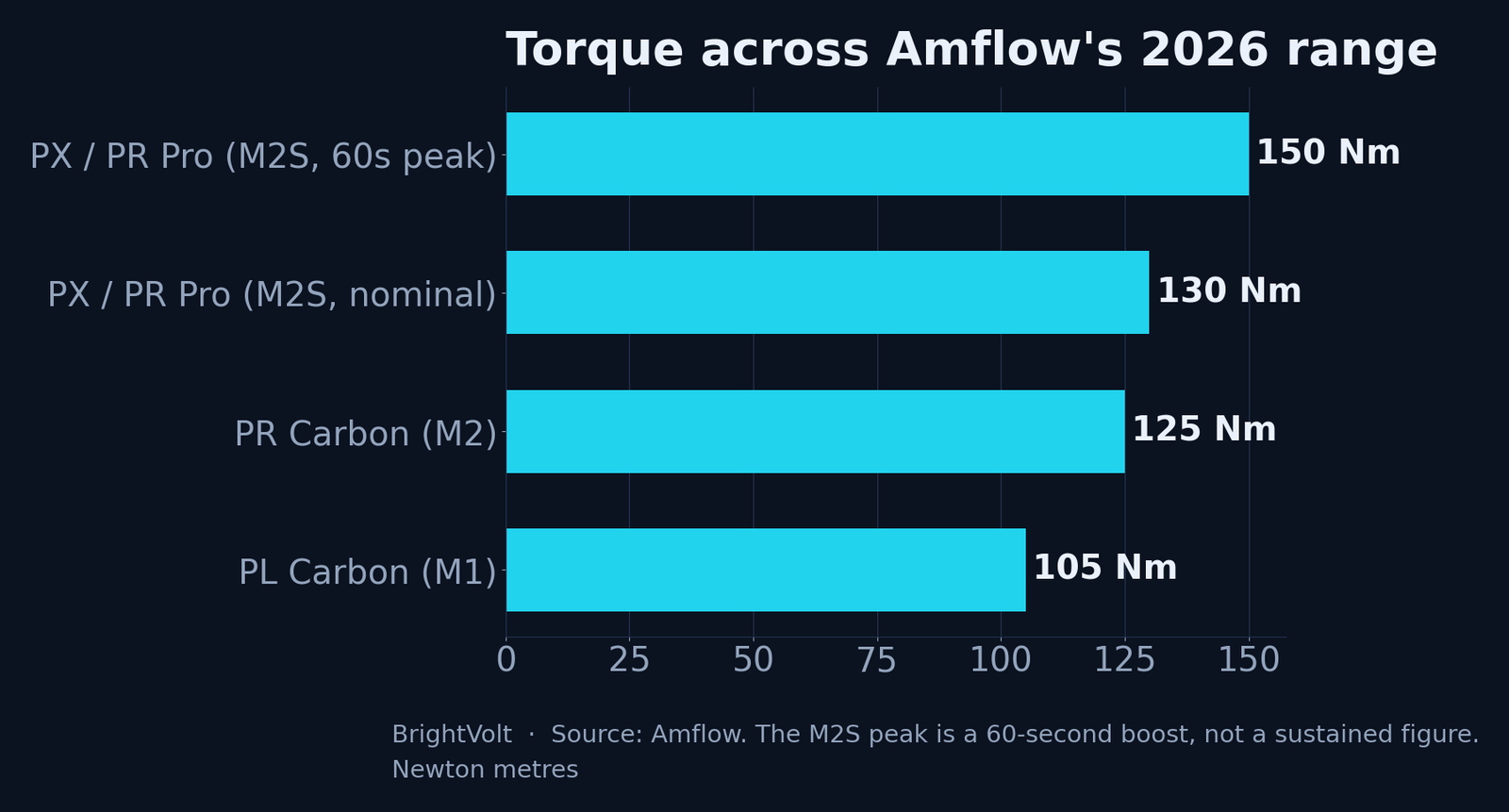
The PL Carbon is the bike that made Amflow’s name, running the original Avinox M1 at 105 Nm with an 800 Wh battery. The PX is the new flagship: Avinox M2S, 700 Wh, mullet wheels, 160 mm front and 150 mm rear travel, from £6,499. The PR is the interesting one commercially — the same 160/150 mm platform with a removable 800 Wh battery, in M2 form at £3,999 or M2S form at £5,399, later this year.
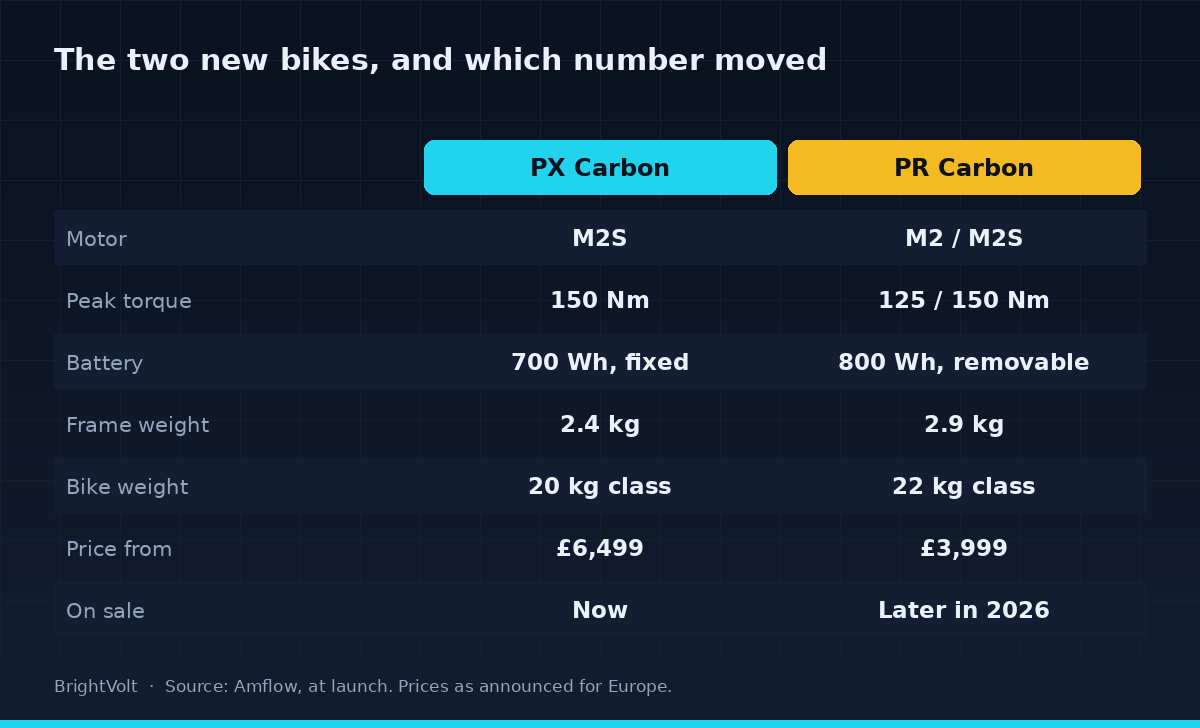
Note which way the battery goes. The lighter, dearer bike has the smaller pack, fixed in the frame. The heavier, cheaper one has the bigger pack and you can take it out. That is a real engineering choice rather than a marketing one, and it is the clearest signal of who each bike is for.
The two power numbers, again
The headline is 1,500 W and 150 Nm. The sustained figure is 1,300 W and 130 Nm; the peak is a 60-second boost. Amflow’s own specification page is straightforward about it, listing the M2S as “Nominal 130 N·m, Peak 150 N·m”.
This is the same structure we picked apart in Gobao’s numbers — a legal or thermal continuous rating alongside a much larger short-term figure — and it is not dishonest in either case. A minute of 150 Nm is exactly what you want for the pitch that would otherwise stop you. It is simply not the number the bike makes while you ride up the hill behind it.
It is also worth noticing that 150 Nm and 1,500 W are precisely the figures circulating for the Avinox MG Concept, the gearbox motor Avinox showed at Eurobike without confirming any specification at all. The simplest reading is that the MG is an M2S with a transmission wrapped around it. That would explain both the silence and the confidence.
The range figure, translated
144 km from a 700 Wh battery is the claim. Divide one by the other and the bike is using 4.9 watt-hours per kilometre.
Put that in terms of the motor. At a 15 km/h average — generous for a mountain bike on anything interesting — 4.9 Wh/km means the motor is contributing about 73 watts. That is less than a moderately fit rider produces with their own legs, and about 6% of what the drive unit can sustain.
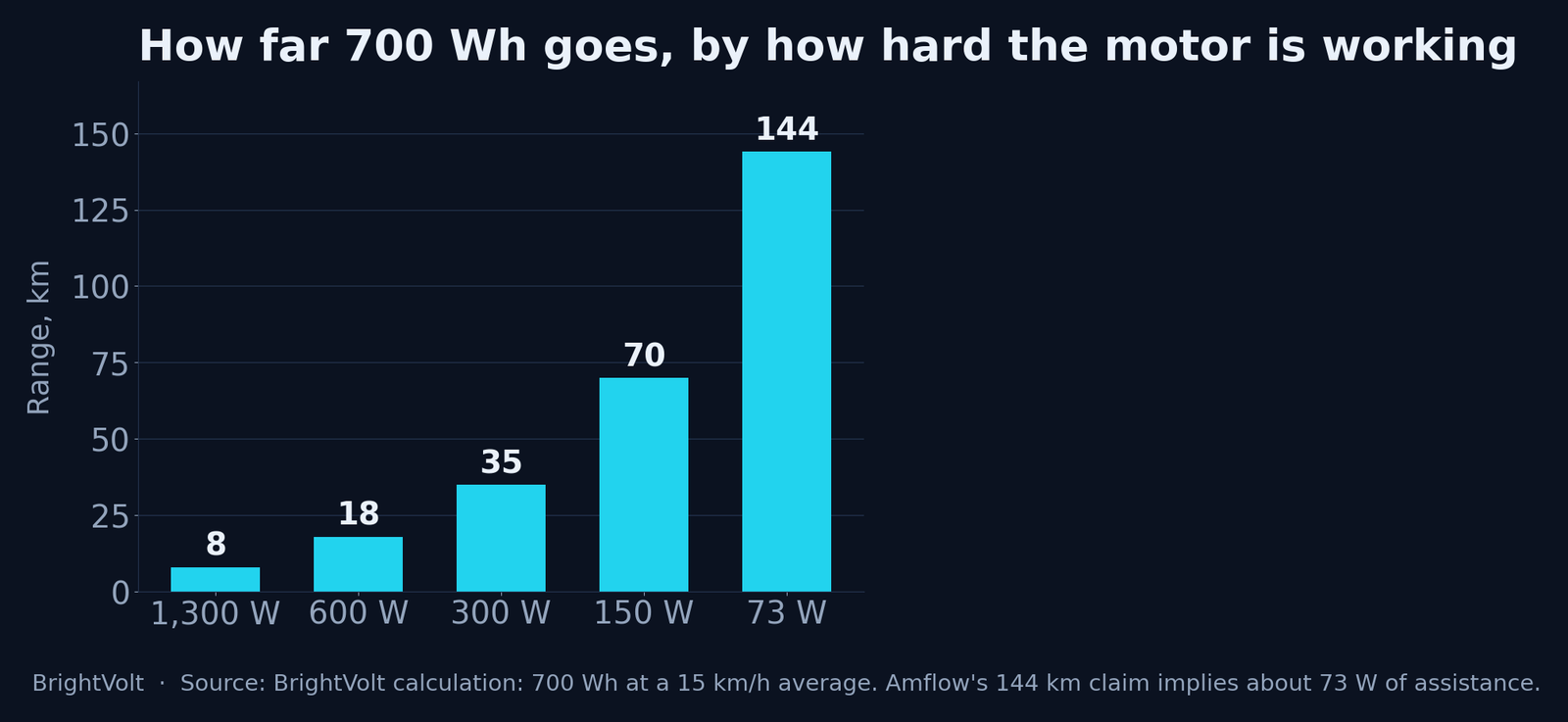
So the honest bracket is wide. Ask the M2S for everything it has and 700 Wh is gone in 32 minutes. Ride it as a slightly-assisted bicycle on smooth ground and 144 km is arithmetically reachable. Neither number describes a normal ride, and the useful figure — what it does in trail mode on real terrain — is one only a tester with a power meter can give you.
None of this is unique to Amflow; every manufacturer quotes a best case. It is worth doing the division anyway, because the division is the only thing that tells you what assumption is buried in the claim.
The battery is the quiet achievement
The specification that deserves more attention than the torque is 220 Wh/kg, the energy density Amflow quotes for the PX pack. The PR’s 800 Wh removable pack at 4 kg works out at 200 Wh/kg.
Those are, as we set out this week, better than almost every electric car on the road — a Porsche Taycan pack manages about 148 Wh/kg, a Tesla Model 3 about 171. The bicycle wins because it does not have to be a crash structure, a cooling system and a fire barrier as well as a battery. Fitting 700 Wh into a down tube while keeping the whole bike in the 20 kg class is where the real engineering went, and it is the least-discussed number on the sheet.
Charging: fast for a bicycle, ordinary in C
Amflow makes a lot of its GaN fast charger: 12 A and 508 W, taking the PX to 80% in about 1 hour 16 minutes and the PR in about 1 hour 36.
For an e-bike that is genuinely quick — most chargers deliver 150 to 250 W and take a working day. But expressed as a C-rate, which is how the rest of the battery world compares charging speeds, it is 0.73C for the PX and 0.64C for the PR.
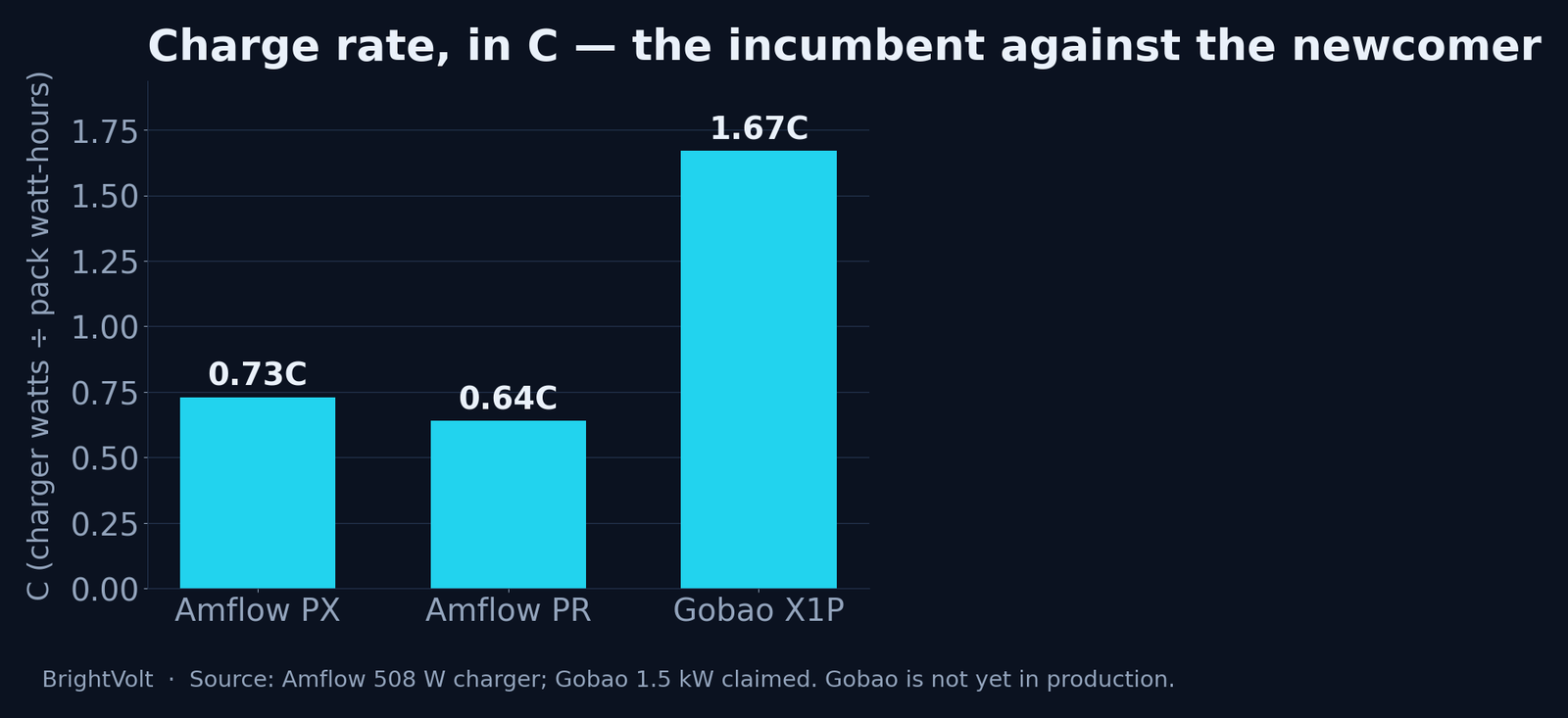
That is the same neighbourhood as a mainstream electric car, and it is less than half what Gobao claims for a pack it has not yet shipped. The gap is the thing to watch: if a company nobody in Europe had heard of two years ago can really sustain 1.7C on a bicycle pack, the fast charger DJI is currently using as a differentiator stops being one.
Forty geometry configurations
The PX and PR carry a five-position head angle adjustment in 0.2° steps, a two-position bottom bracket flip chip and a four-position rear centre. Five times two times four is the forty in the press release.
Whether that is a feature or a homework assignment is a fair question — Flow Mountain Bike’s first look raised exactly this, wondering aloud about riders endlessly hunting the Goldilocks setting. What it unambiguously is, though, is cheap for DJI to offer and expensive for a traditional bike brand to match, because it is largely a matter of designing the hardware points in once. That is a manufacturing-scale advantage showing up as a spec-sheet advantage, which is a pattern worth recognising.
The number that actually matters
£3,999 for a carbon enduro bike with 125 Nm, 800 Wh and Fox suspension.
That is the figure that should worry the established brands, and it is the same move DJI made in drones: arrive with a product that is competitive on capability, then price it where the incumbent’s margin lives. The e-MTB market has spent a decade with full-power carbon bikes starting around £7,000 — the level at which, as Pinion’s gearbox motor found out, good engineering goes to die commercially.
The counter-argument is real and worth stating. Amflow is three years old as a bicycle brand, dealer networks and warranty support are what actually keep an expensive bike on the trail, and a fixed battery on the PX means the pack’s lifespan and the frame’s are now the same conversation. Those are the things a spec sheet cannot tell you, and they are the things that decide whether a cheap bike is good value.
What to watch
Whether the PR ships at £3,999, and when. A price announced in April for a bike arriving “later in 2026” is a statement of intent, not an invoice.
Whether independent testers publish measured consumption in Wh/km rather than range in kilometres, because that is the only figure that makes two e-MTBs comparable and almost nobody prints it.
And whether the MG gearbox motor turns up in an Amflow frame first. Avinox sells to more than 60 brands, but it is owned by the company that also owns the bike brand — and the first bike built around a derailleur-free drive is going to be a good deal easier to design in-house.
Image: Amflow