
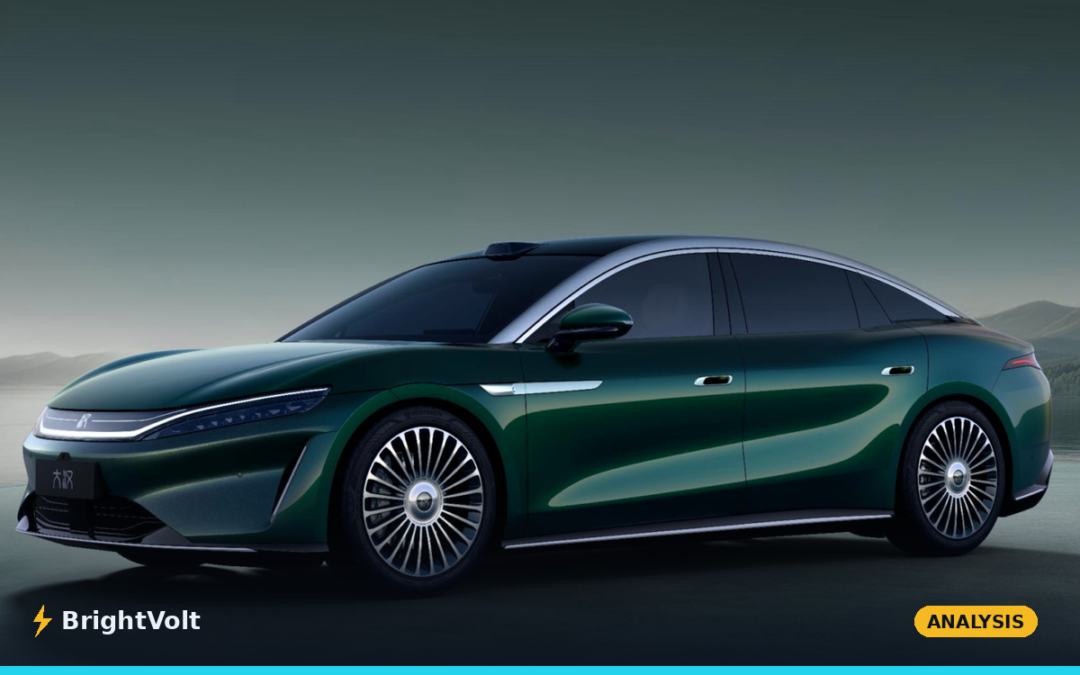
BYD’s new Da Han flagship, launched on 13 October, pairs a 1,008 km range claim with a 10-to-97% charge in nine minutes. The battery behind both numbers is a modest 102.3 kWh — the same pack BYD drops into cars that travel a third less far. The range is not coming from the cell.
It is coming from the shape of the car. That is the more interesting story, and the cheaper one.
What a 102 kWh battery is and isn’t doing here
The pack is unremarkable, and deliberately so. BYD’s MIIT regulatory filing lists the single-motor Da Han on a 102.326 kWh second-generation Blade Battery — lithium iron phosphate, 725.9 kg, a pack-level density of 141 Wh/kg. Those are mid-table numbers. A Lucid Air Grand Touring carries 117 kWh; a Mercedes EQS 450+ about 118. BYD’s flagship undercuts both on capacity and still claims more range than either.
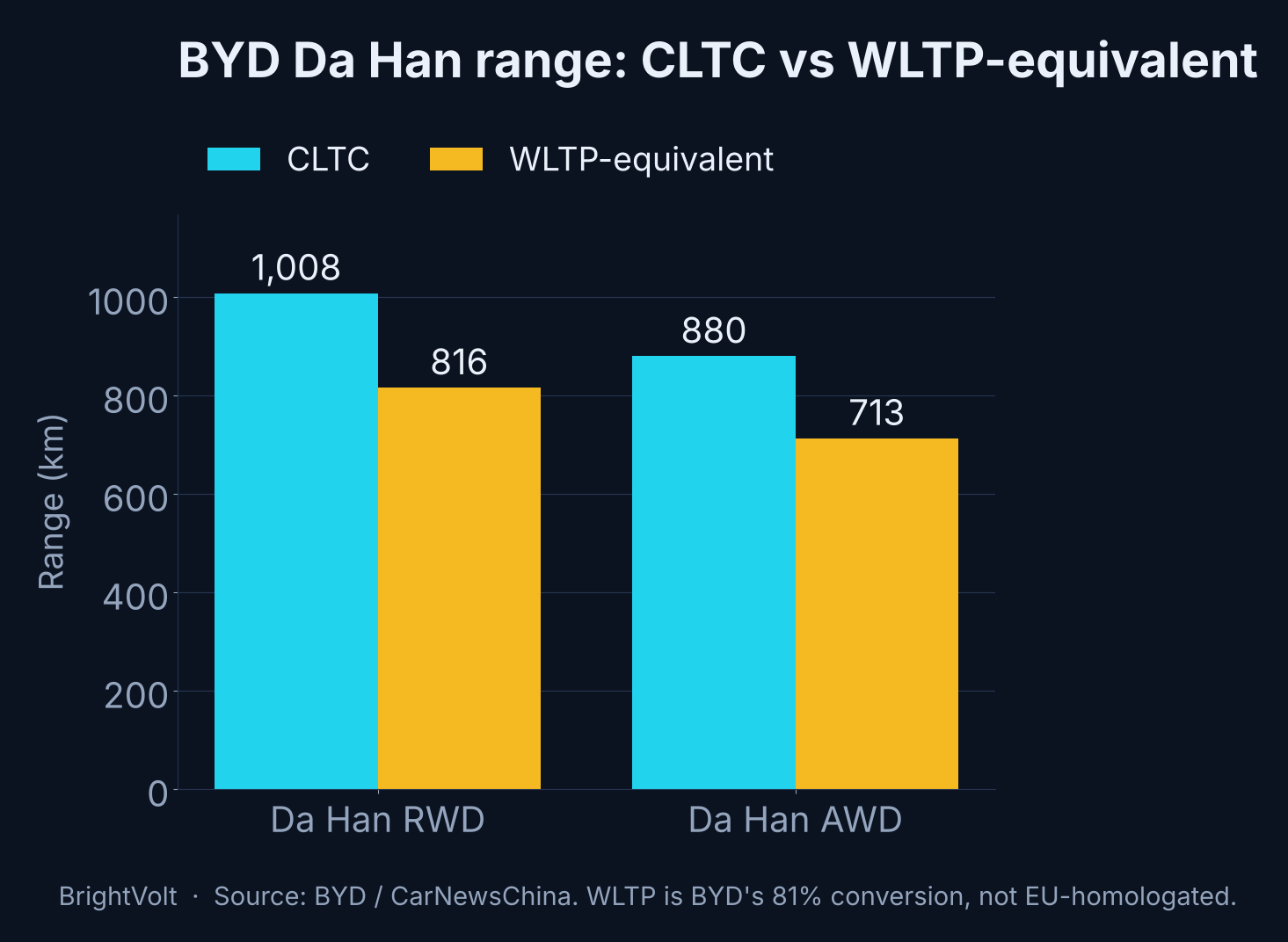
So the arithmetic has to give somewhere, and it gives in efficiency. A 1,008 km figure on China’s CLTC cycle converts to 816 km on the stricter WLTP standard, which on a 102.3 kWh pack works out to roughly 125 watt-hours per kilometre. For a car 5,256 mm long — longer than a 7 Series — that is an aggressive number.
It is also, for once, a believable one. The contrast that makes it so is a car BrightVolt took apart three weeks ago. The Denza Z9S, BYD’s own record-holder, runs the same 102.3 kWh pack in its lower trims — but to claim its 1,100 km headline it had to fit a 122.5 kWh battery, a fifth larger, and even then the implied consumption came out at 137 Wh/km for a full-size SUV. That figure never survived scrutiny: no two-tonne wardrobe uses less energy than a Tesla Model 3. The Da Han is the inverse case. Same cell, same chemistry, a lower and far slipperier body — and the efficiency the Z9S had to fake, the sedan can plausibly earn.
Where 1,008 km actually comes from
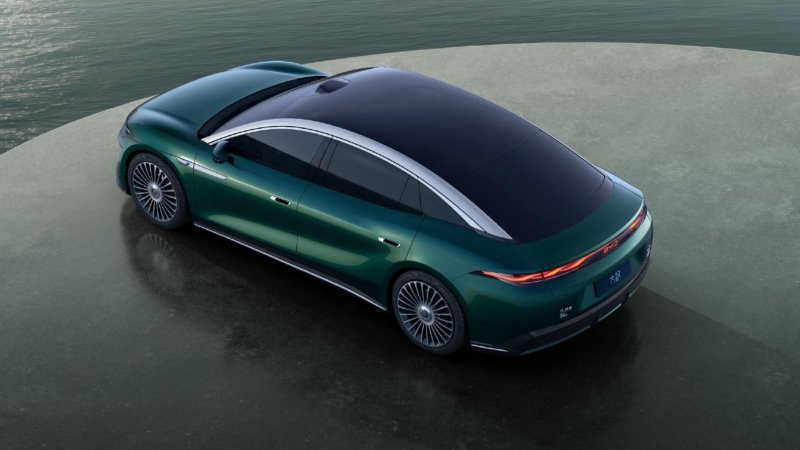
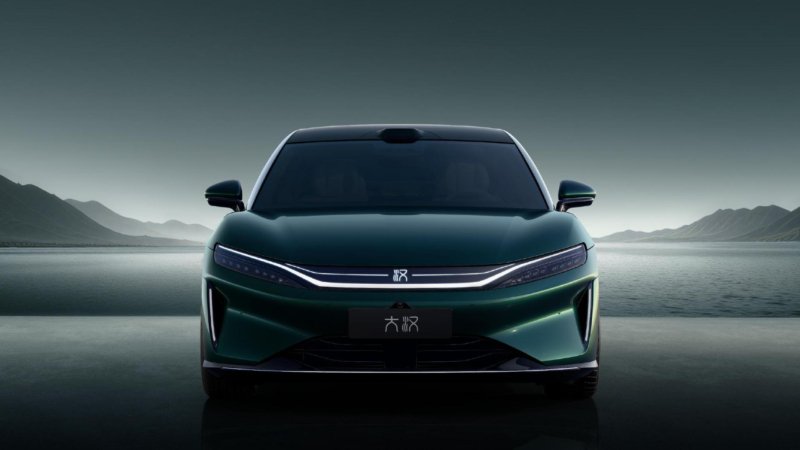
The mechanism is a drag coefficient of 0.197. That ties the Da Han with the Lucid Air for the slipperiest shape in series production, and it is the whole game at motorway speed, where aerodynamic drag — not weight, not rolling resistance — is most of what a battery is fighting.
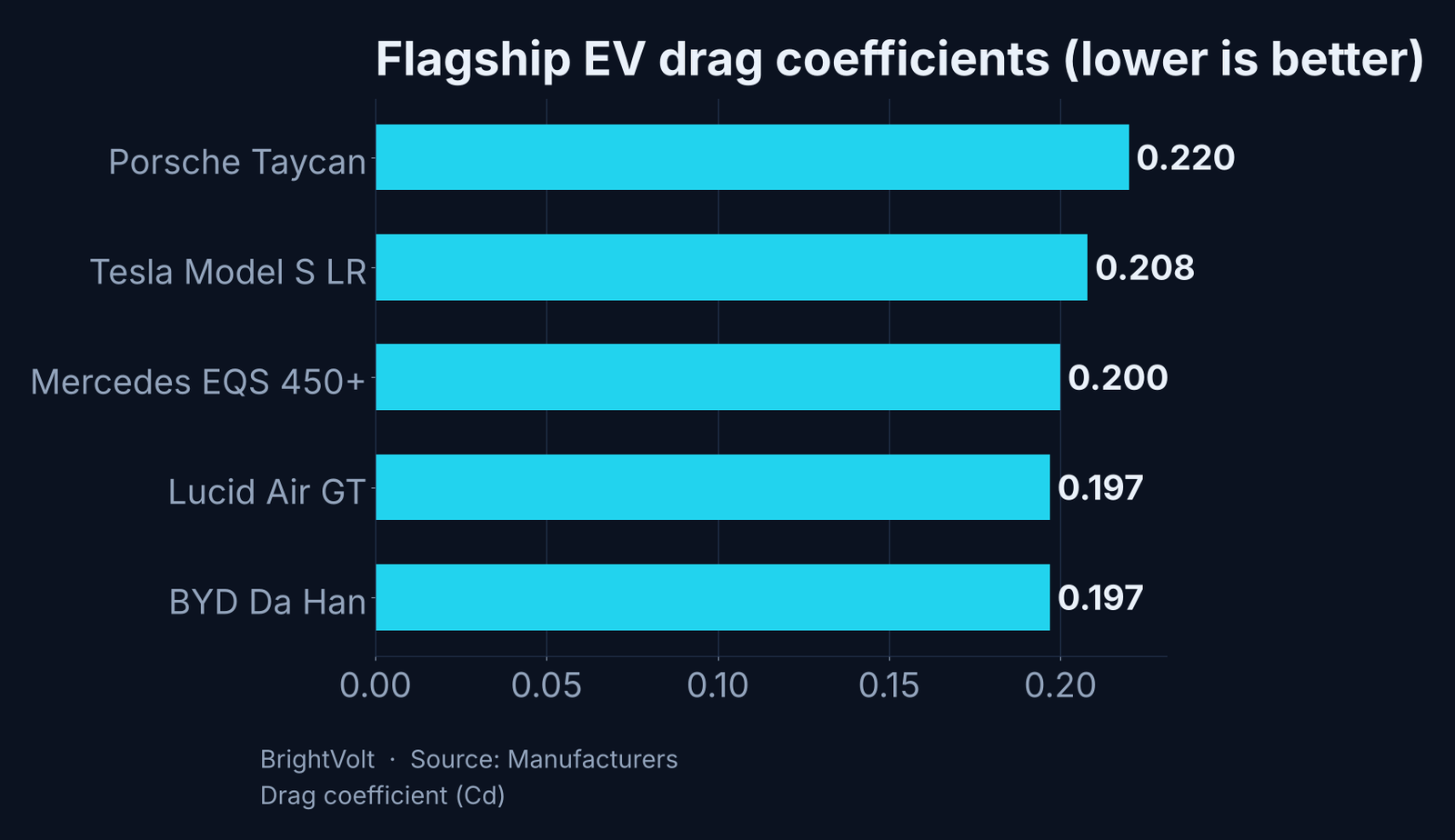
Line the Da Han up against the saloons it will never share a showroom with and the pattern is clean: 0.197 for the Da Han and the Lucid, 0.20 for the EQS, 0.208 for the Tesla Model S, 0.22 for the Porsche Taycan. BYD has spent its engineering budget on the body — the frontal area, the underfloor, the near-flush everything — rather than on exotic cells, and the range is the dividend.
That still leaves the cycle caveat, and it is the same one that dogs every Chinese range claim. The 1,008 km is a CLTC number, and CLTC runs slow, flat and gentle in exactly the conditions where an EV bleeds range. BYD’s own WLTP-equivalent figure is 816 km — and 816 divided by 1,008 is 0.810, the identical 81% house factor the Denza Z9S used. BrightVolt’s Denza Z9S breakdown walks through why the test cycles diverge; the short version is that the Da Han carries no European type approval, so even the 816 is a calculation, not a measurement. Treat 1,008 km as the marketing number and 816 as the optimistic-but-plausible one.
| Sedan | Usable battery | Headline range | Drag (Cd) | From |
|---|---|---|---|---|
| BYD Da Han (RWD) | 102.3 kWh | 1,008 km CLTC (≈816 WLTP) | 0.197 | ¥235,900 (~$33,000) |
| BYD Da Han (AWD) | 102.3 kWh | 880 km CLTC (≈713 WLTP) | 0.197 | ¥275,900 (~$39,000) |
| Lucid Air Grand Touring | 117 kWh | 960 km WLTP | 0.197 | ~$110,000 |
| Mercedes EQS 450+ | 118 kWh | 770 km WLTP | 0.20 | ~$105,000 |
| Tesla Model S Long Range | 95 kWh | 634 km WLTP | 0.208 | ~$80,000 |
The price line is the one that should worry Stuttgart. The AWD Da Han makes 570 kW — 764 hp — and reaches 100 km/h in 3.3 seconds, for roughly a third of what an EQS costs.
The nine-minute number, unpacked
“Fully charged in nine minutes” is not quite what happens. The figure CarNewsChina reported from the launch is 10% to 97% in nine minutes, and only at a BYD flash-charging station. Move 87% of a 102.3 kWh pack — about 89 kWh — in nine minutes and you are averaging close to 590 kW across the session. That is a real, large number. It is an average, not a peak, and it needs a charger almost nobody has yet.
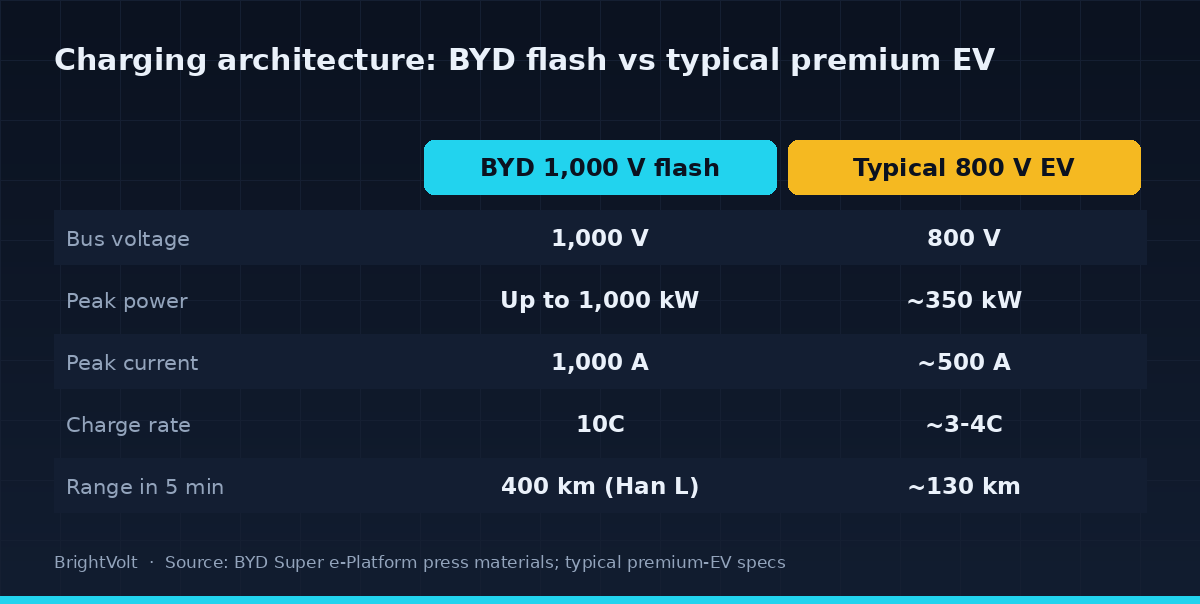
The charger is the second half of the story, and it is where BYD has quietly changed the rules. Its Super e-Platform runs a full 1,000-volt architecture at up to 1,000 amps — a megawatt, a 10C charge rate, 400 km of range added in five minutes on the Han L. Most premium EVs sit on an 800-volt bus and tap out around 350 kW. BrightVolt has covered why a headline charging figure rarely reaches the plug; the point here is the direction of travel. BYD is solving range anxiety at the pillar, not only in the pack.
Why aero-plus-charging beats chasing the cell
The industry has spent a decade waiting on the battery to fix range, and the battery keeps not arriving on schedule. Solid-state is still a 2027 promise at best, and energy density creeps up a few percent a year. Aerodynamics and charging voltage move faster and cost less. A 0.197 drag coefficient is a styling and tooling problem, solved once and stamped into every car off the line. A 1,000-volt bus is power electronics, not chemistry. Neither needs a laboratory breakthrough, and both ship today.
That is why the Da Han matters beyond its own sales. BYD has shown that the 1,000 km, ten-minute-charge car does not require a new cell — it requires a slippery body, a high-voltage bus, and the cheap LFP pack the company already makes by the gigawatt-hour. That recipe is copy-paste down a lineup in a way a cell breakthrough never is. The expensive part of the Da Han is the bodywork and the charging electronics, and both get cheaper with volume.
What would prove this wrong
The weak point is the one the Z9S exposed. If independent testing — a European homologation, or an honest highway run — shows the Da Han needs far more than its claimed consumption to hit 1,008 km in the real world, then the aero story quietly becomes a bigger-tank story after all, and the 102.3 kWh pack was never doing the work the brochure implies. Watch for two things: a certified WLTP figure if the car reaches Europe, and whether the nine-minute charge holds outside a BYD flash station and in winter. Until then, the honest reading is that BYD has built a genuinely efficient car and wrapped it in a genuinely inflated number — and that the efficiency, not the number, is the part worth copying.
Image: BYD