
On 4 September Li Auto paid 2.65 billion yuan, about $390 million, for 8.79% of Sunwoda EVB — a board seat at China’s seventh-largest battery maker, so it can design its own cells and pay someone else to build them. It is the third premium Chinese carmaker, after BYD and Xpeng, to move battery design in-house. In the same year CATL’s half-year profit rose nearly 42% and its global share held near 40%. The market leader has never made more money, and its best customers have never been keener to stop buying from it. The gap between those two facts is the story.
What Li Auto actually bought
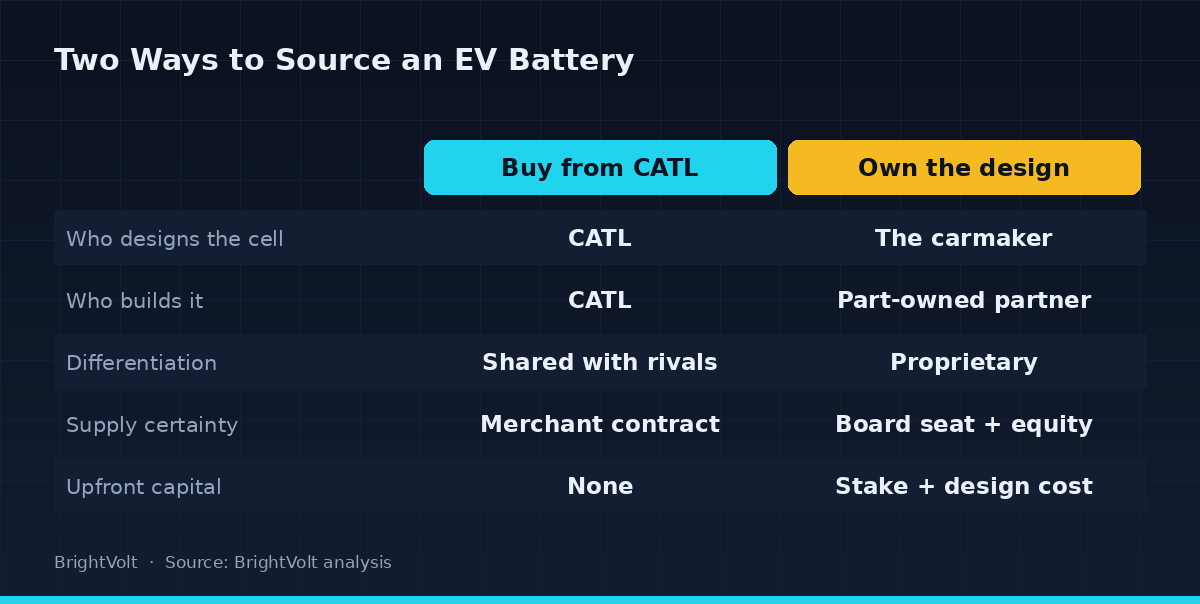
Not a divorce. Li Auto signed a five-year supply agreement with CATL in September 2025, still runs what it calls a “diversified battery supply system,” and its new i9 will launch this month on CATL cells before switching to its own. What changed is where the design authority sits. Under the Sunwoda deal, Li Auto specifies the cell — materials, structure, battery-management system — and Sunwoda’s factories build to that spec. The carmaker owns the recipe; the supplier owns the oven.
That is a deliberate arrangement, and an expensive one. Sunwoda EVB ranked seventh in China’s battery market in July on a 3.59% share, posted 15.53 billion yuan of first-half revenue and lost 324 million yuan doing it. Li Auto did not buy into it for the returns. It bought a manufacturing partner it can direct, a second-largest-shareholder’s influence over how the line is run, and a supply of the 5C in-house cells it plans to spread across its lineup through the second half of 2026 — the Mega Home from September, the refreshed i6 in the fourth quarter. The point was never a cheaper battery. It was a battery Li Auto controls.
Li Auto’s own words make the motive explicit. “Battery technology is not a commodity,” its power-battery director Liu Zhimin said of the shift. “By controlling the underlying design and manufacturing standards, we ensure both the certainty of supply and the ability to innovate rapidly.” Read that as a rejection of the buy-from-the-giant model — from a company that until this year was one of the giant’s larger customers.
The pattern CATL keeps losing to
Li Auto is not an outlier. It is the newest name on a list that has been growing for four years, and the list is made of exactly the buyers a supplier least wants to lose.
| Carmaker | Battery model | Since |
|---|---|---|
| BYD | Fully captive — makes its own Blade LFP cells | Always |
| Xpeng | Dropped CATL as primary supplier; EVE, CALB, Sunwoda, then self-developed and semi-solid | 2022 |
| Li Auto | In-house 5C design, contract-built by part-owned Sunwoda | 2026 |
| Geely | Self-developed solid-state pack, vehicle testing under way | 2026 |
| Nio | In-house cell and pack programme, plus swap-station standardisation | Ongoing |
The through-line is that vertical integration is easiest to justify at the top of the range. A premium carmaker sells on drivetrain, charging speed and software, and the cell is the largest single input to all three; owning its design is owning the product. That is the same logic that made BYD’s captive model work — BYD’s cells go into BYD’s cars, so its battery “market share” is really its car sales wearing a different hat. Li Auto is copying the structure without owning a gigafactory: design in-house, manufacture through a supplier it sits on the board of. It gets most of the control for a fraction of the capital.
CATL’s response to all this is not to fight for those customers. It is to grow where they cannot reach.
The numbers that say CATL is fine
They are emphatic. In the first half of 2026 CATL booked 276.9 billion yuan of revenue and 43.3 billion of net profit, up 41.98% year on year. Its global EV-battery installations grew 25.3% to 242.7 GWh, a 39.9% share — still nearly three times BYD’s, in a market that itself grew only 20%. Energy storage is now 19.2% of the company, and that line grew almost 88%. Overseas sales reached 31.5% of revenue at a fatter margin than domestic ones — 29.97% gross against 21.16% at home. CATL is the world’s number-one grid-battery shipper and the world’s number-one EV-battery maker at the same time, and it is compounding.
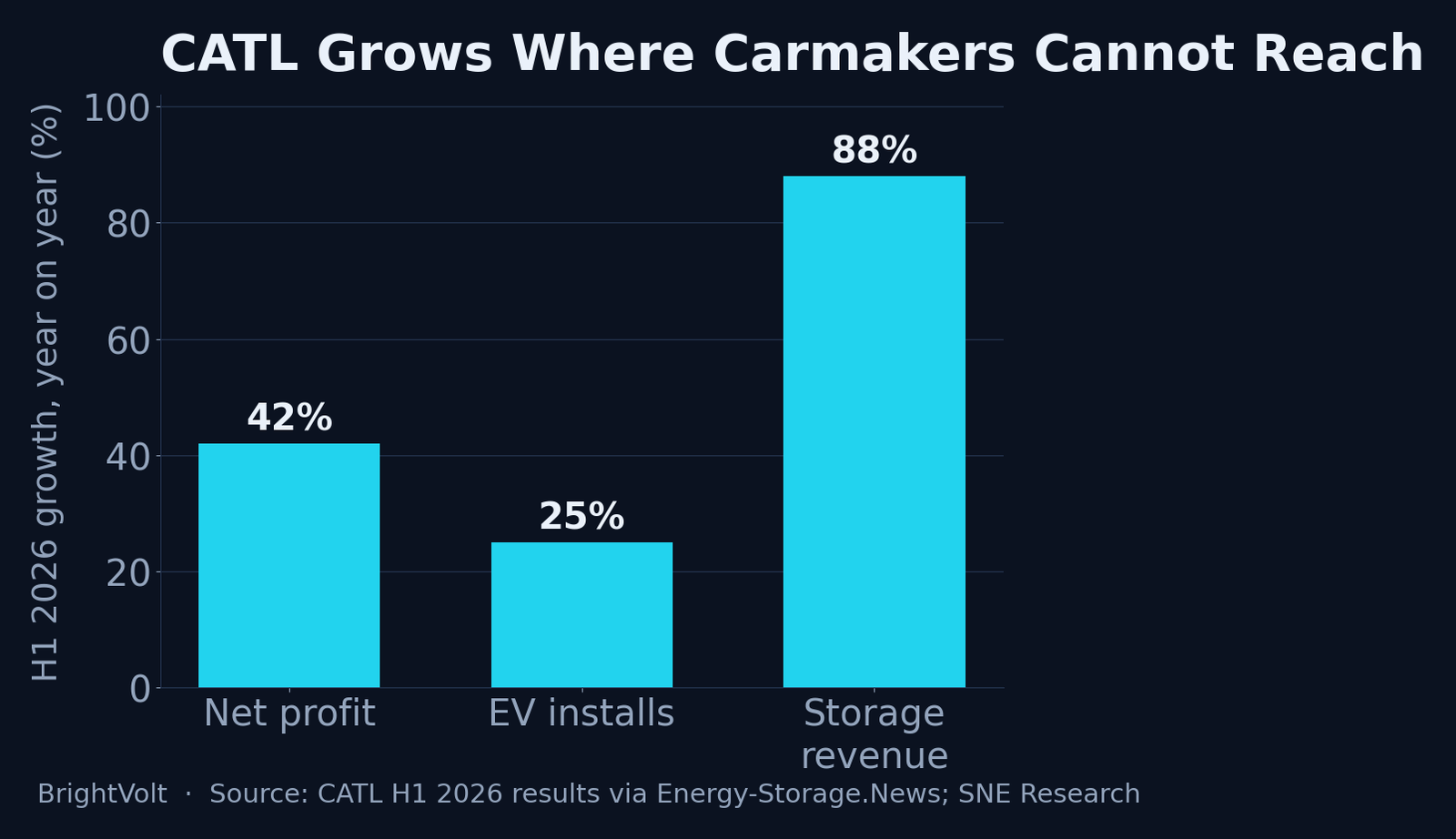
So the case that Li Auto’s $390 million is a rounding error writes itself. Lose a premium carmaker and you keep the storage boom, the overseas margin and the four hundred smaller customers who will never build a cell. Storage and export are precisely the arenas where a carmaker’s in-house programme is irrelevant — a data-centre operator or a grid utility is not going to design its own battery, and Li Auto’s 5C pack does nothing for a shipping container of LFP bound for Texas.
The one number that doesn’t
Here is the figure the profit line hides. CATL’s share of its home market has been slipping all year — from 45.54% in March to 42.33% in July — and its cumulative global share has drifted with it, from 42.1% at the start of the year to 39.9% by midyear. A company growing installations 25% while its share falls is a company growing slower than the market it leads. The absolute number is up because the pie is exploding; the slice is thinning.
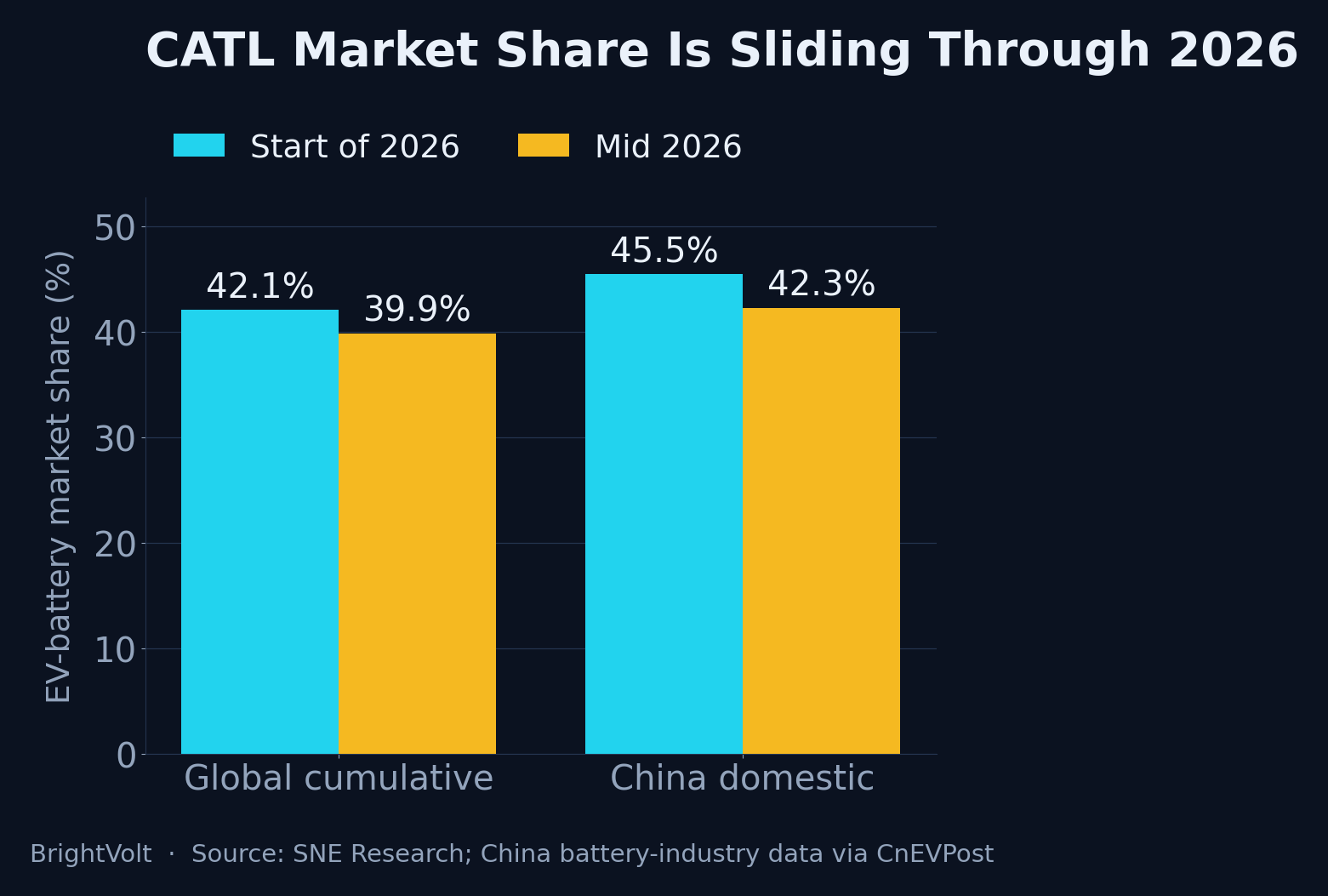
And it is thinning at the visible end. The customers integrating away are not the marginal ones — they are BYD, Xpeng, Li Auto, Geely, the brands that set the technology frontier and carry the prestige. What CATL keeps is the storage container, the export pallet and the cheaper model whose maker cannot afford to build cells. That is a good, profitable business. It is also a different business from the one CATL had five years ago, when its cell was the thing inside China’s best cars. The migration is from irreplaceable partner toward volume supplier — and a volume supplier is a commodity supplier.
The commodity trap, sprung on the man who built it
There is an irony CATL should sit with. Two weeks ago we watched it list LFP cells online at about $63 a kilowatt-hour, a public reference price that turned its own core product into a commodity to squeeze the weak producers beneath it. Beijing reinforced the same campaign from the fiscal side, taxing lithium and zero-rating sodium to force consolidation. Commoditisation was CATL’s weapon. But a commodity is a thing you buy on price and specification, from whoever offers the best of both — and once the cell is that, a sophisticated buyer’s next thought is why it is buying at all rather than making. The force CATL aimed at its weak rivals is the same one teaching its strong customers to walk. “Battery technology is not a commodity” is Li Auto insisting on the opposite, and building a supply chain to prove it.
None of this is a crisis. CATL will lead the industry in 2027 and probably 2030, on storage and export if not on premium Chinese cars, and its licensing model — selling not just cells but the know-how to make them — may yet turn the integrators into a different kind of customer. The thing to watch is narrower and sharper than “is CATL in trouble.” Watch whether its China share stabilises through the back half of 2026, or keeps sliding. Watch whether Li Auto’s in-house 5C packs actually ship at a cost that beats buying from CATL — because building good cells cheaply at scale is the one thing CATL is better at than anyone alive, and more than one carmaker’s vertical-integration dream has quietly gone back to the merchant. If the share steadies and the in-house packs turn out to cost more, the giant was never really threatened. If the slide continues and the packs pencil out, the most profitable battery maker in history is being slowly, deliberately designed out of the cars that made its name.
Photo by Hilary Halliwell on Pexels · Photo by Ayyeee Ayyeee on Pexels