
BYD opened pre-orders for the Sealion 08 on 13 August, and the two numbers doing the rounds are 900 km of range and a charge from 10% to 97% in nine minutes. Both are real claims from BYD. Both mean something different from what they sound like.
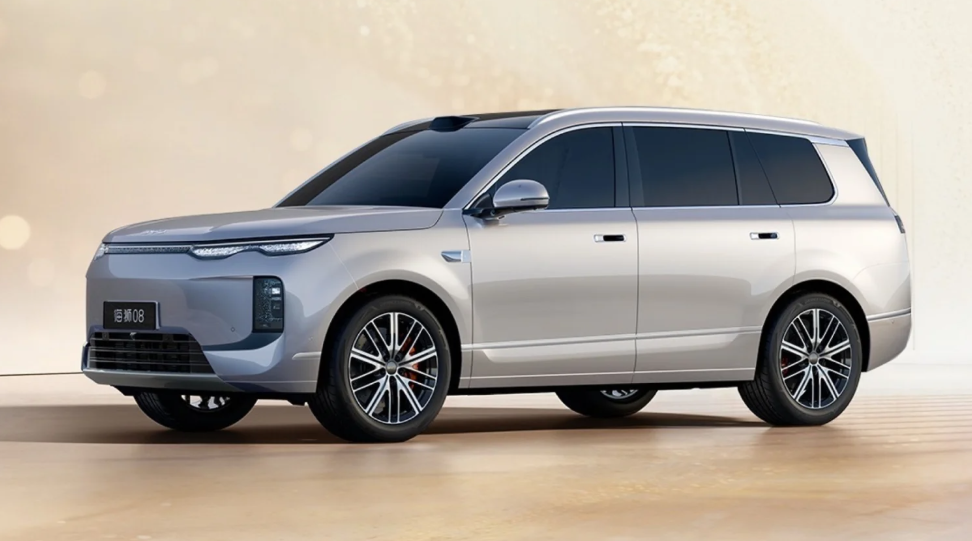
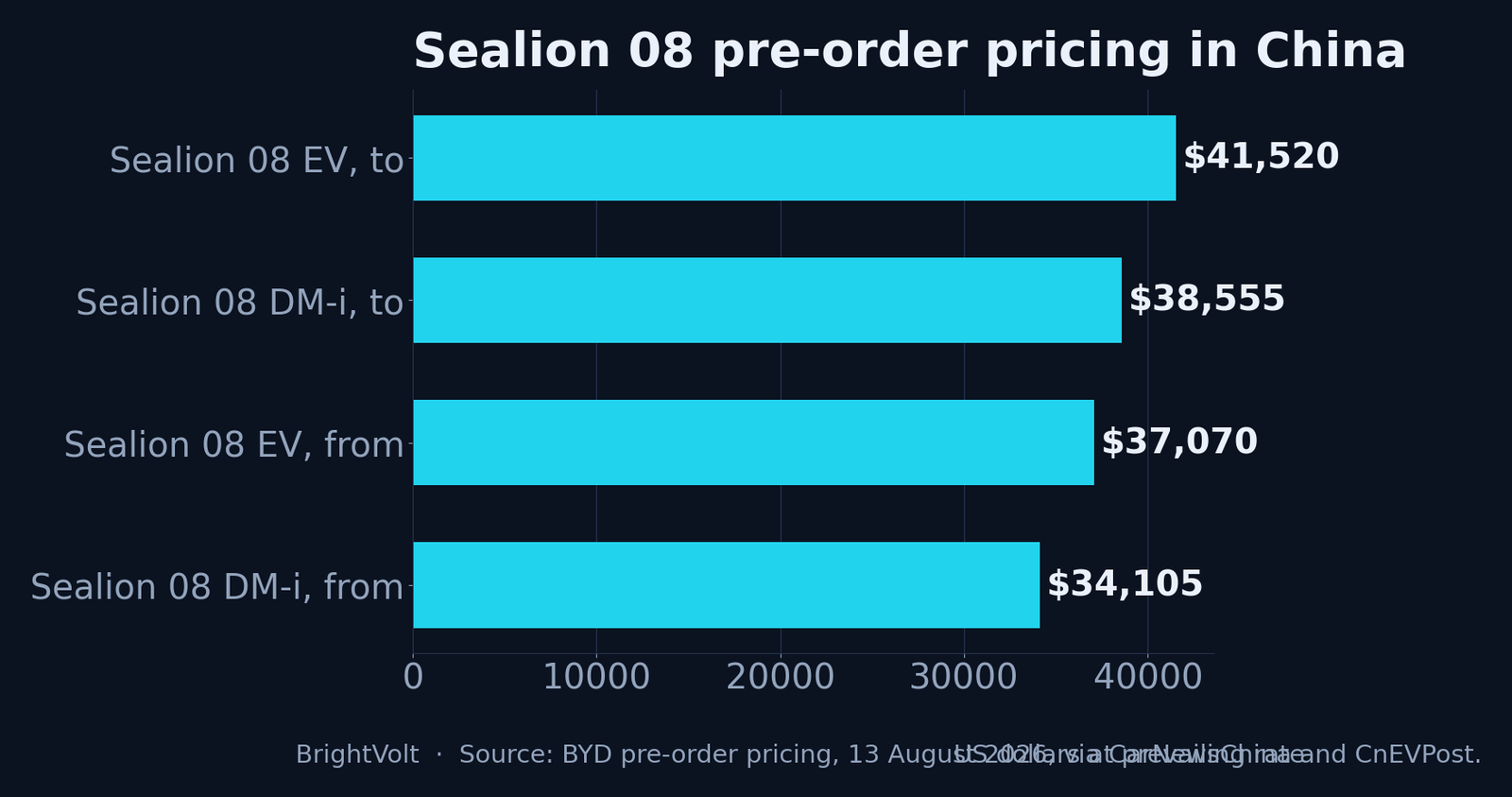
The car itself is straightforward enough. It is the flagship SUV of BYD’s Ocean line, five metres long on a 3,030 mm wheelbase, five or six seats, in plug-in hybrid and battery-electric forms. Pre-orders open at 230,000 yuan, about $34,105, against a refundable 2,000 yuan deposit.
What the price ladder looks like
The DM-i plug-in hybrid runs from 230,000 to 260,000 yuan; the battery-electric from 250,000 to 280,000 yuan, roughly $37,070 to $41,520. For a five-metre, six-seat SUV with a 115 kWh pack at the top of the range, that is aggressive even by the standards of the Chinese price war — and BYD has spent this summer setting record discounts on cars already in the showroom.
The PHEV pairs a 1.5-litre engine making 115 kW with a 200 kW motor and a 55.84 kWh LFP pack, which is a larger battery than many small EVs carry. The electric version offers 92.093 kWh or 115.072 kWh, second-generation Blade cells, and outputs from 320 kW rear-drive to 585 kW in dual-motor form.
Where it sits, and why the price is the story
The Sealion 08 is the second of two Ocean flagships, arriving after the Seal 08 saloon that launched in July. Together they are BYD’s attempt to hold the top of its own range while the bottom of the Chinese market is being fought over on price, and the six-seat option is the tell: this is aimed squarely at the family buyer who would otherwise be looking at a Li Auto or an Aito, not at anyone cross-shopping a Model Y.
The context is a domestic market that has shrunk for seven straight months even as headline NEV figures rise on exports. Launching a five-metre flagship into that is not a confident act so much as a necessary one — margin has to come from somewhere when the volume cars are discounting, and BYD is one of only three Chinese NEV makers that turned a profit last year. A well-equipped 115 kWh six-seater at $41,520 is what competing for the profitable end of a contracting market looks like.
The range figure, translated
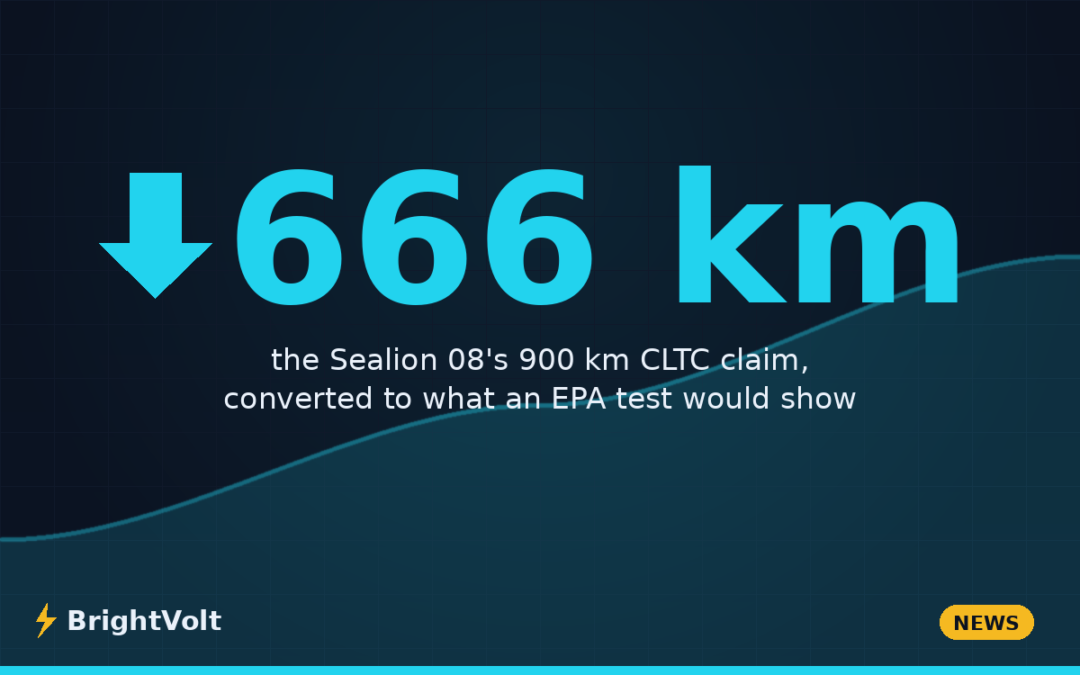
BYD quotes 710 to 900 km. That is CLTC, China’s own test cycle, and it is substantially more generous than EPA — by our working ratio, an EPA-equivalent figure is roughly 26% lower.
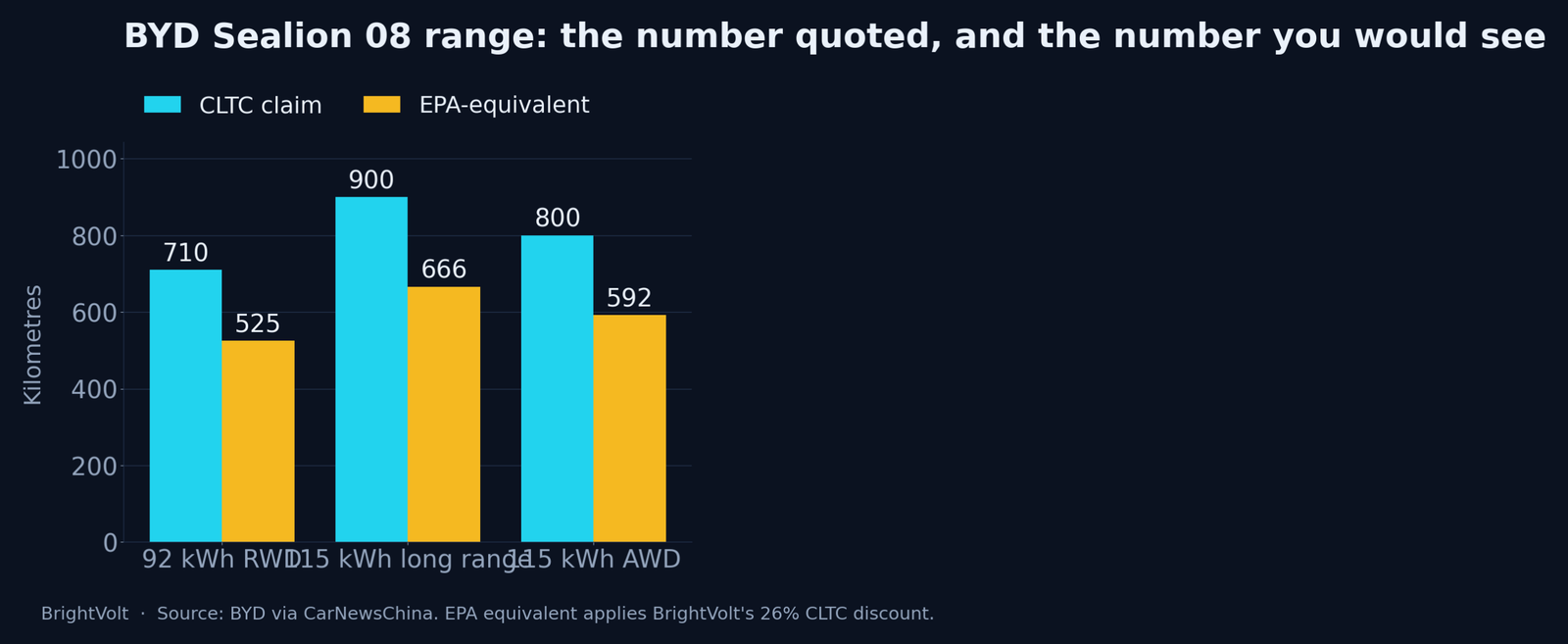
So the 900 km flagship is about 666 km on the yardstick an American or European buyer would recognise, and the 710 km entry car is about 525 km. Those are still excellent numbers for the money. They are not the numbers on the poster, and every outlet that reprints 900 km without saying which cycle produced it is publishing a figure the car will not deliver anywhere outside China.
The same applies to the PHEV’s 400 km of electric range: call it about 296 km EPA-equivalent, which is still more usable electric range than most plug-in hybrids on sale anywhere.
The nine-minute claim, translated
This is the more interesting one. Take BYD at its word: 10% to 97% of a 115.072 kWh pack in nine minutes. That is 87% of the pack, or roughly 100 kWh, moved in 0.15 hours — an average of about 667 kW, sustained.
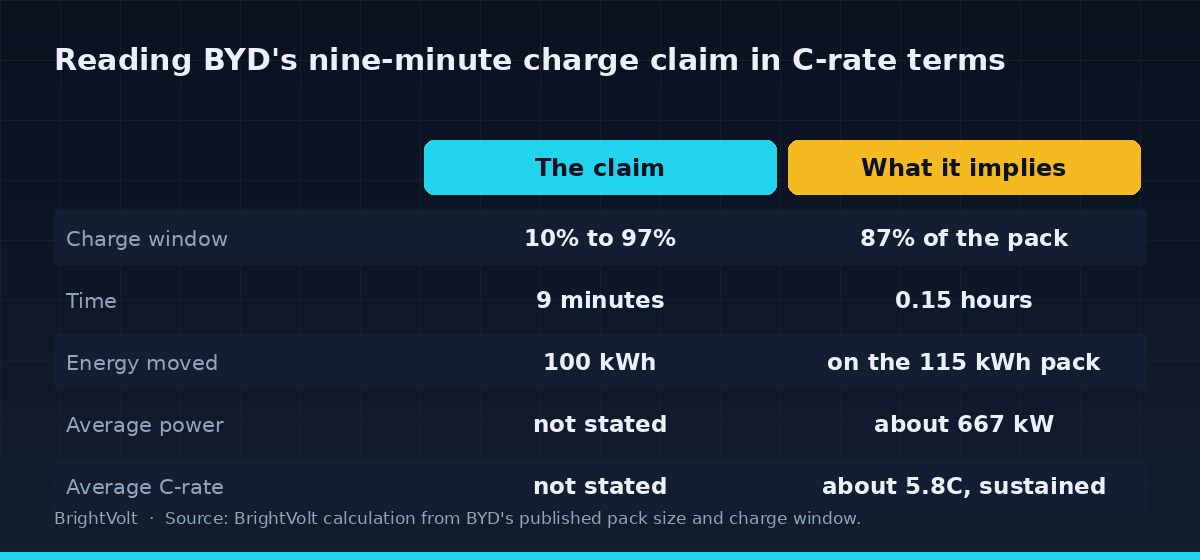
Expressed as a C-rate, that is about 5.8C averaged across the whole window, not as a peak. The distinction matters more than the headline does. Every fast-charging curve tapers, and it tapers hardest above 80% state of charge, because a nearly full graphite anode is where lithium plating becomes a real risk. A claim that runs to 97% without the taper eating the clock is a claim that the taper has largely been engineered out.
That is either a genuinely remarkable cell, or a figure measured under conditions — pack preconditioned to the ideal temperature, on BYD’s own megawatt-class hardware, at a site with the grid connection to sustain it — that almost no owner will meet on a given Tuesday. Both can be true at once. What we would need to settle it is a published charging curve rather than a window, and BYD has not released one.
It is worth remembering how few chargers can even attempt this. Sustaining 667 kW to a single car is beyond nearly every public charger in the world, and the cars are once again arriving before the forecourts.
What to watch
Three things will tell you whether the Sealion 08 is as good as the spec sheet. Whether BYD publishes an actual charging curve, which would convert the nine-minute claim from a marketing window into something checkable. What the car achieves on WLTP if and when it reaches Europe, which will be the first independent read on the range. And what it is priced at outside China, because a $34,000 five-metre six-seat SUV does not stay a $34,000 car once tariffs and homologation are added.
Until then the honest summary is that this is a very good car being described in the most flattering available units — which is standard practice, and precisely why the units are worth knowing.