
Over China’s eight-day National Day holiday, electric vehicles drew 163 million kilowatt-hours from expressway chargers — up 51 percent on a year earlier, and a record 28 million kWh on October 1 alone. The network carried it. At a handful of service areas, drivers still waited seven hours for a plug.
Both of those things are true, and the gap between them is the whole story. China has built the largest public charging network on earth and it works — for 51 weeks of the year. The holiday is the week it is tested the way nothing else tests it, and the test is not really about how many chargers exist.

What the National Day numbers actually show
The headline figure is the eight-day total: 163 million kWh across the national monitoring platform’s expressway chargers, a daily average of 23.26 million, up 51.42 percent year on year on the National Energy Administration’s count. The first three days alone ran to 71.62 million kWh and 2.97 million charging sessions — roughly 24 kWh a session, about a third of a mid-size pack. People do not top up on the motorway. They charge because they have to.
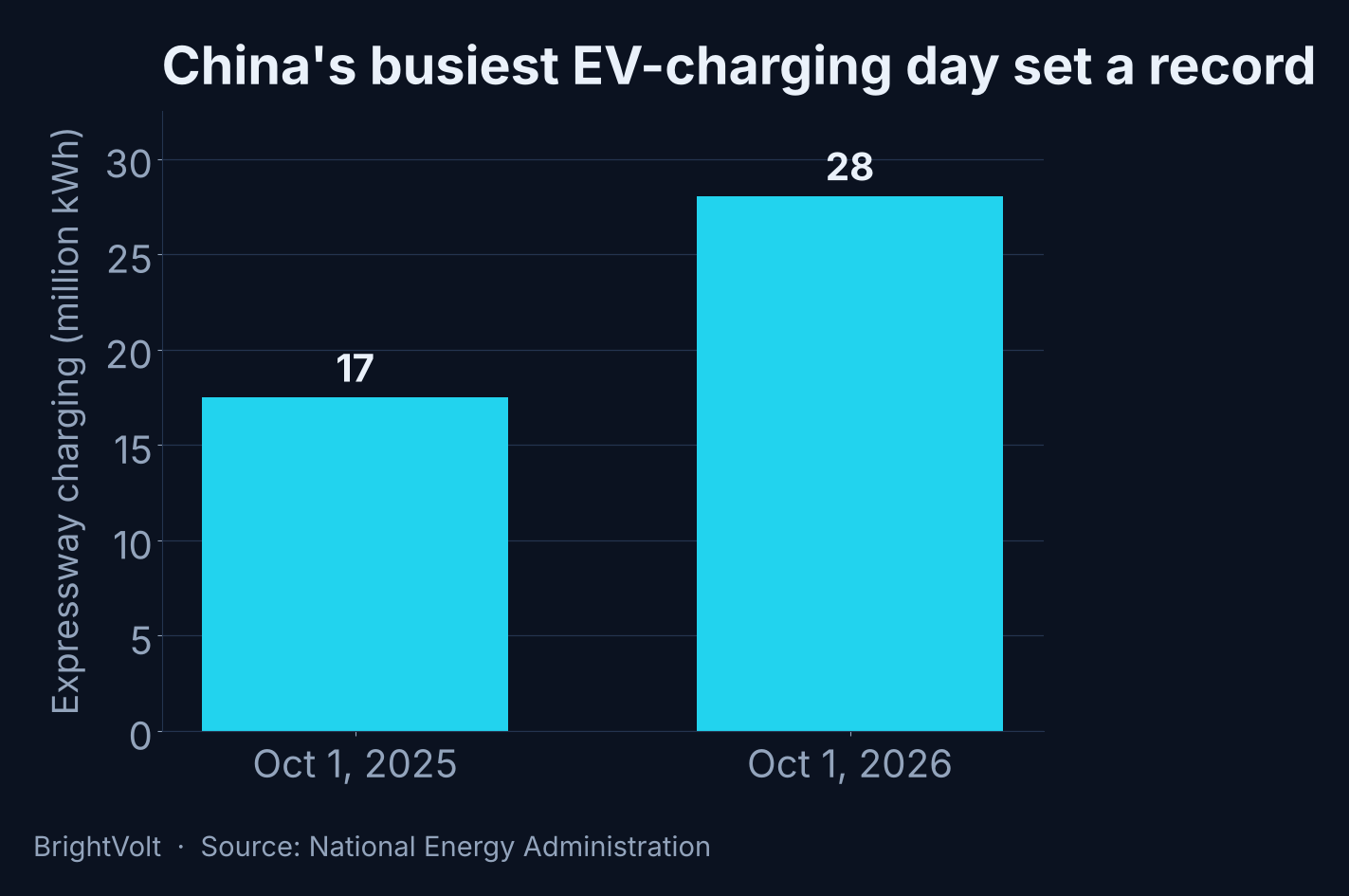
The single most revealing number is from day one. On October 1, the busiest travel day of the year, expressway chargers delivered 28.05 million kWh — the NEA’s record for any single holiday day, and up 60.4 percent from 17.49 million a year earlier. That 60 percent did not come from 60 percent more chargers. The monitoring platform watched 62,700 connectors at service areas, up 29.5 percent on last year’s 48,400. Each one pushed out 447 kWh over the day, up 23.8 percent. Multiply the two and you get the 60 percent: a bit under a third more plugs, each working a bit under a quarter harder.
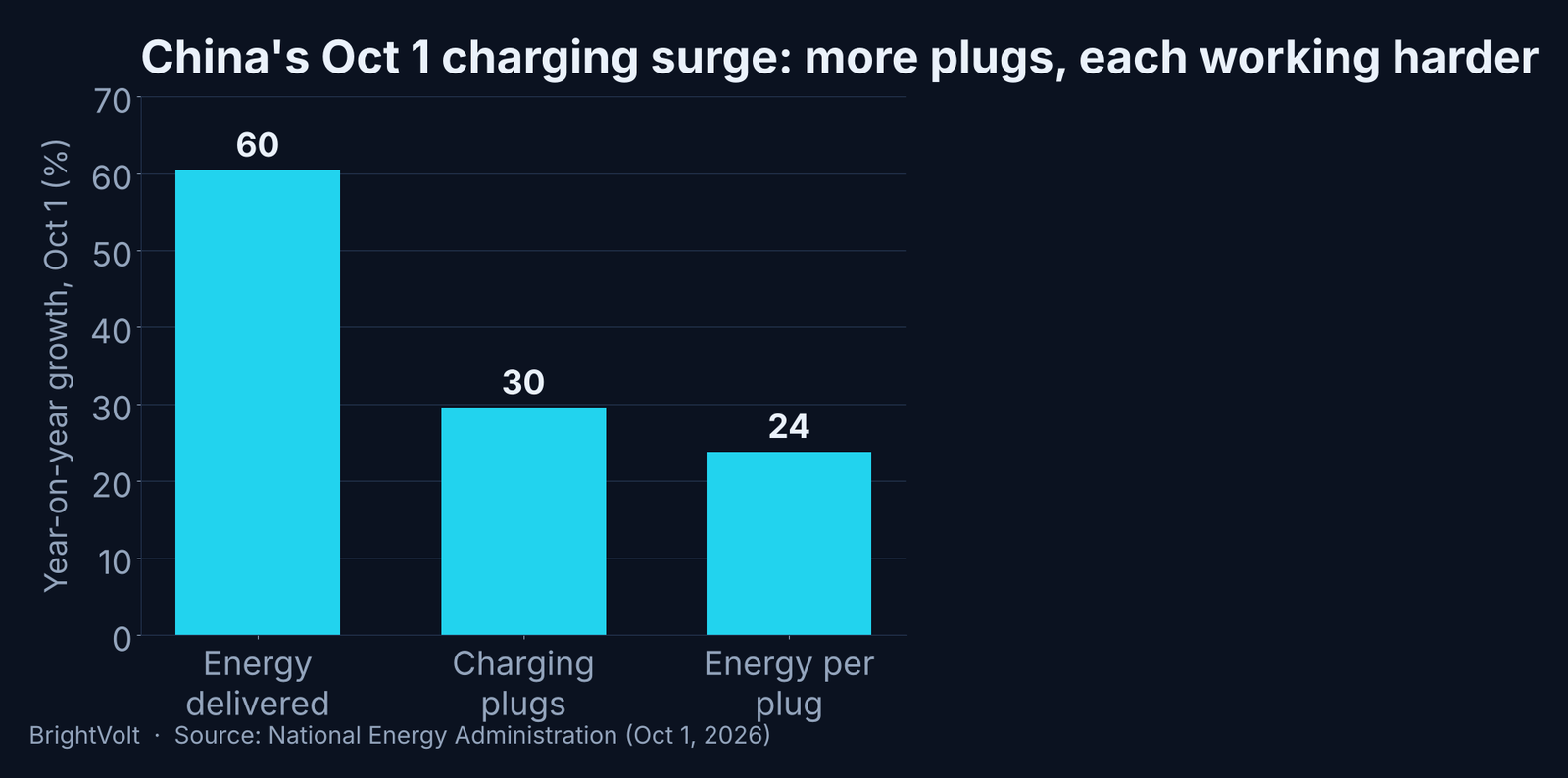
That decomposition is the quiet alarm in an otherwise triumphant data release. When demand outruns the plug count, the slack is taken up by each plug running closer to flat out — and a charger running flat out is a charger with a line in front of it. Utilisation rising faster than hardware is exactly what a queue looks like in a spreadsheet.
Why the queues survive a network this big
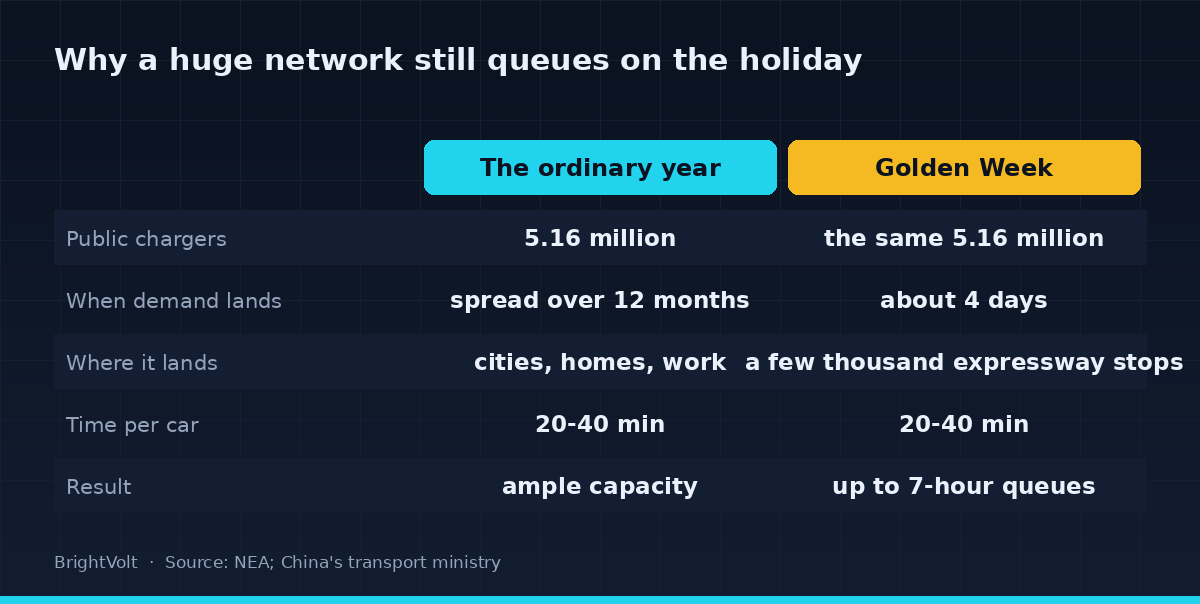
China crossed 5.16 million public chargers by the end of August, up 19.5 percent in a year, with 262 million kW of rated power behind them. On paper there is no shortage. The reason a driver in Gansu still spent seven hours overnight at a G75 service area, and another drew queue number 99 and waited more than five, is that a national average is the wrong unit for a holiday.
The problem is concentration, in three dimensions at once. Hundreds of millions of people travel inside the same four-day window. They funnel onto the expressway network, where charging is only possible at a few thousand service areas. And an EV cannot do what a petrol car does — pull in, spend four minutes at the pump, and leave — so even a high-power charger holds each car for twenty to forty minutes. Demand that is spread thin across the country for most of the year arrives, on October 1, as a spike landing on a tiny number of physical points, each of which serves cars slowly by design.
No plausible number of chargers fixes a peak this sharp, because building for the October 1 spike means leaving the hardware idle for the other 360 days. This is the same mismatch a grid faces with its annual demand peak, and the economics are just as unforgiving. The service-area charger that clears the Gansu queue is a peaker plant with a cable: expensive to build, mostly unused, and indispensable for a few hours a year.
China’s answer is surge capacity, not more average capacity
Because you cannot out-build a peak, the response has shifted to things that only appear when the peak does. Three moves stand out from this holiday.
First, concentrate the fast hardware where the spike lands. Of roughly 89,000 charging connectors at expressway service areas, about 22,000 are now high-power units, the transport ministry said in late September, with some 11,000 of those added between January and August. The buildout is deliberately aimed at the choke points rather than at the national total.
Second, bring in capacity that can be moved or switched on for the week and removed after. State Grid wheeled out 32 mobile charging trucks and wired in 599 temporary connectors for the holiday. Battery swapping did the same job by other means: NIO’s network logged more than two million charging and swap services over the eight days, with a single-day record of 183,664 swaps on October 5 and its busiest highway station turning round 211 cars in a day. A swap takes minutes and sidesteps the queue entirely, which on a travel day is worth more than the kilowatt-hours.
| Where the surge capacity came from | This holiday |
|---|---|
| High-power connectors at service areas | ~22,000 of ~89,000 total; ~11,000 added Jan–Aug |
| State Grid mobile charging trucks | 32 deployed |
| State Grid temporary connectors | 599 wired in for the week |
| NIO battery swaps, single-day record | 183,664 (October 5) |
| NIO charging and swap services, eight days | over 2 million |
Third, lean on the grid underneath. China Southern Power Grid’s platform alone delivered 10.44 million kWh on October 1, up 24.5 percent. For sites where the local feed cannot support a wall of fast chargers, the emerging fix is to put a battery behind the charger and let it absorb the spike — surge capacity stored on site rather than trucked in.
What the next holiday will test
The NEA called service-area charging “generally smooth,” and for most drivers it was: plenty waited thirty minutes or less. The honest reading is that the network is winning the race, but not by much. Demand on the peak day grew 60 percent; the connector count grew 30. As long as that gap persists, the marginal driver at the worst-placed service area pays for it in hours, and no triumphant national total erases that.
There is a larger shift underneath the queue stories, and it is the more important number. Of the 63.5 million car trips taken over the break, about one in five was electric or hybrid, and China’s holiday gasoline demand is now falling year on year rather than spiking the way it always used to. The traffic jam at the charger is the visible cost of a quieter victory: the fuel that was not burned.
Watch two things next October. Whether the high-power buildout rate — roughly 11,000 units in eight months — can close the gap on 50-to-60 percent annual demand growth at the service areas that matter, or whether swapping and mobile trucks become permanent holiday fixtures because the fixed network structurally cannot. And whether anyone publishes a worst-case wait that is shorter than this year’s seven hours. If the records keep climbing while the longest queue keeps shrinking, the network is genuinely catching up. If both climb together, it is only keeping pace with a peak that grows faster than anything built to meet it.
Photo by Andrew Seltz on Pexels · Photo by Andrew Seltz on Pexels