
A battery-buffered fast charger has a battery pack built into the cabinet, so it can hand a car far more power than its grid connection supplies. FreeWire’s Boost Charger 200 delivers 200 kW from an electrical service rated at 27 kW. The 160 kWh battery inside covers the difference. The grid trickles in all day; the car drinks fast.
That arithmetic — small connection, large delivery — is why a growing share of DC fast chargers now ship with their own batteries. The reason is not the cell in the car. It is the wire in the ground.
What a battery-buffered charger actually is
A buffered charger splits the rate it takes power from the grid from the rate it gives power to a car. A conventional fast charger is a passthrough: 350 kW into the car means 350 kW pulled from the grid at that instant, and the local connection has to be sized for the peak. A buffered charger puts a stationary battery between the two, so the grid feed can be a fraction of the output and the battery makes up the rest in the moment it is needed.
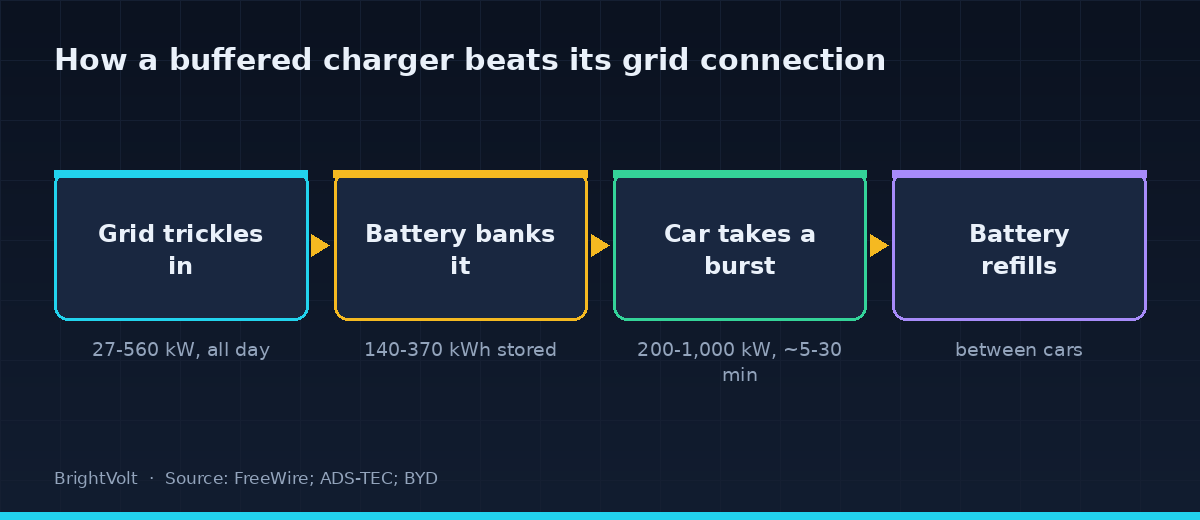
The mechanism is the same one a behind-the-meter battery performs in a house or a factory: it decouples the rate you can draw power from the rate you want to use it. Picture a bathtub filling a bucket. The tap runs slowly and steadily; the bucket, once full, empties in one go. The tap never has to match the pour.
Why a charger would carry its own battery
Two problems push an operator toward a battery, and they are different problems. The first is a hard ceiling: the grid connection a site can actually get. A single megawatt-class charger can want more power than a suburban block, and supplying it means a new transformer, thicker cable and often a substation upgrade — equipment now on multi-year lead times across most of the world. A battery lets the operator install a 200 kW charger on a connection that would otherwise carry a single slow charger, and skip the dig. FreeWire markets the Boost as connecting “to the existing low-voltage grid,” installed “in hours”; ADS-TEC sells its ChargeBox on exactly the same promise — up to 320 kW from a 140 kWh pack, which it advertises as “5x more charging power on power-limited grids.”
The second problem is price, not physics. Commercial sites pay demand charges — a fee set by the single highest 15-minute spike of power drawn in a month — and a fast charger is a machine for creating exactly such spikes. A battery flattens them. Electric Era, which builds battery-backed charging stations, says its system cuts peak power consumption by up to 70%; at an eight-stall, 200 kW site it co-funded in Arlington, Washington, it reported roughly 70% lower operating costs and no grid upgrade at all. The same battery can also bank cheap off-peak energy and sell it back during the expensive evening, turning the charger into a small arbitrage asset when it is not charging cars.
The spec that gives it away: output versus grid draw
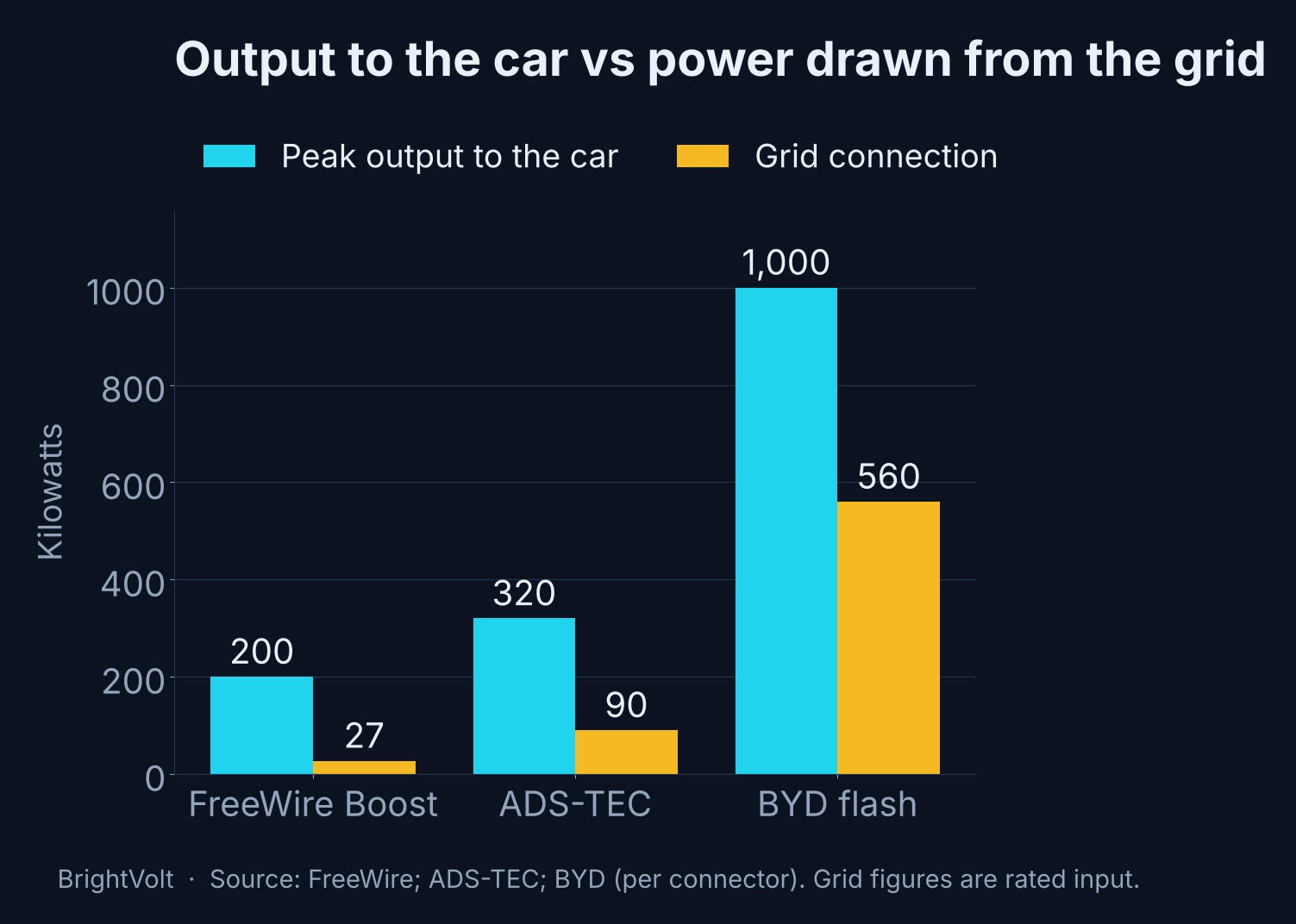
The tell is the gap between the two power figures on the datasheet. On an ordinary charger they are the same number. On a buffered one, the output is a multiple of the grid draw, and the size of that multiple is the whole design.
| Charger | Peak output to the car | Grid connection | On-site battery |
|---|---|---|---|
| FreeWire Boost 200 | 200 kW | ≤27 kW | 160 kWh |
| ADS-TEC ChargeBox | up to 320 kW | 50–110 kVA | 140 kWh |
| BYD flash charger (Gen 2) | up to 1,000 kW per connector | ~100–560 kW | 370 kWh per terminal |
BYD sits at the other end of the same spectrum. Its second-generation flash charger draws 100–560 kW from the grid to push up to 1,000 kW into a car, bridged by battery cabinets holding 370 kWh per terminal — the engineering behind its nine-minute charge. Its multiplier is smaller than FreeWire’s because it draws far more to begin with, but the principle is identical: the grid never delivers the headline number. A battery does.
Where the trick stops working
A buffered charger is only as fast as its battery is full. Deliver 200 kW from a 27 kW feed and the 160 kWh pack empties in well under an hour of heavy use; once it is drawn down, the charger can only hand out what the grid gives it, which is the 27 kW it was trying to escape. Buffering does not create energy. It reshapes when the energy is taken, and that reshaping only holds if there is slack between sessions for the battery to refill.
That is the crossover that decides where these chargers belong. At a workplace, a shop or a depot — moderate traffic, long gaps, a weak connection — the battery recharges between cars and the economics are excellent. At a motorway hub serving a continuous queue, the battery would sit permanently flat, and the site needs a genuine high-power connection regardless; a buffer there buys little except a bigger capital bill. There are losses to pay, too: every kilowatt-hour makes a round trip through the battery, and even ADS-TEC’s headline 96% efficiency figure is a one-way, best-case number that a full charge-and-discharge cycle erodes further. A battery that is cycled hard every day also degrades, which is a replacement cost a plain charger never carries.
So the honest rule is narrow. Buffering wins where the grid is the binding constraint and the duty cycle is intermittent. It loses where the grid is strong or the throughput is relentless.
What to watch
The spread of battery-buffered chargers is a bet that the grid connection, not the cell’s willingness to accept charge, stays the bottleneck — and for now that bet is sound, because transformers and substations are the slowest, most back-ordered part of the whole system. The question is how long it holds. If grid connections become cheap and quick, the buffer battery becomes dead weight and the category thins out. If megawatt charging on open networks becomes normal, as BYD is already pushing on its own closed network, the buffer stops being a clever workaround and becomes standard plumbing. Either way, the next time a charger promises more power than its street could plausibly supply, the datasheet will answer the question it raises: look for the second battery, the one bolted to the charger rather than sitting in the car.
Photo by Reinhard Bruckner on Pexels · Photo by Erik Mclean on Pexels